











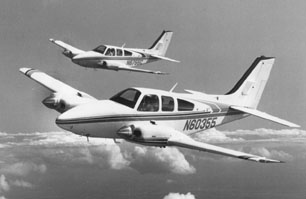
Beechcraft in general-and the Baron in particular-have a well-deserved top-of-the-GA-heap reputation for quality. Theyre we’ll made, have good handling and are excellent performers, often leading their class in speed.
But nothing comes for free. Few owners call their Barons cheap to own and the airplanes do have some quirks that prompt some would-be owners to sip from another cup of tea. And like most GA aircraft, the 55 Baron embodies certain compromises.
For instance, what many find to be pleasant handling characteristics can prove to be a handful in bad weather or when the bumps get ugly.
Although Barons are comfortable with a largish cabin, they also require pilots upgrading to undergo serious training and, if insurers have anything to say about it, recurrent training as well.
In the current market-the fall of 2003-55 Barons represent good buys but also good investments for pilots who already happen to own them. While the prices of other light twins have tanked due to a sour economy and high gas prices, Barons have declined less. But there’s enough softness in the market for the canny buyer to negotiate a good deal.
Model History
Although Beech isn’t quite the master of the parts-bin model evolution that Piper is, the Baron has nonetheless been through some changes.
Like the Bonanza, it comes in two sizes, long- (58) and short-cabin (55). There are several sub-types: The 58 could be had for a time with turbocharged engines and, if desired, pressurization. There arent many P-Barons flying around and today, only the long-body 58 remains in production. (If you want one, plan on an invoice we’ll north of $1 million.)
The Model 55 was Beechs first Baron. It was introduced in 1961 as a replacement for the Model 95 Travel Air, which was a bit long in the tooth to meet competition from Cessnas 310 and Pipers Aztec. Like the Travel Air, the 55 comprised a Bonanza fuselage fitted with a conventional tail, not the V-tail. In place of the Travel Airs somewhat anemic 180-HP Lycomings, the original Baron had 260-HP Continental IO-470L engines.
After building 190 Barons that first year, Beech came out with the A55, which has a 10-inch longer fuselage and could be ordered with a second fold-down rear seat, bringing potential seating capacity to six (more on that later).
A total of 309 A55s were built in 1962 and 1963. The airplanes nose then was extended seven inches to provide more room for baggage and avionics equipment and gross weight was bumped from 4880 to 5000 pounds.
The airplane was re-designated B55. This version remained in production the longest, until 1983, when all 55s were dropped from the line, along with the 58TC and V-tail Bonanza. Browsing the for-sale ads, expect to see more B55s than any other model.
Beech built 1954 of the long-nose B55s from 1964 through 1982, not including about 70 T-42A versions for the U.S. Army. Among a number of minor refinements during this time was an increase in gross weight to 5100 pounds, starting with S/N TC-955 in mid-1965. Earlier B55s were eligible for the higher gross through a Beech STC kit.
The big-engine version arrived two years after the B55. The C55 Baron appeared in 1966 with a 12-inch longer fuselage and 285-HP Continental IO-520C engines.
The little Baron with the big engines also was certified with a gross weight of 5300 pounds. The airplane was re-designated the D55 in 1968 and the E55 in 1970. It, too, was dropped from production in 1983, after 1201 were built, 451 Cs, 316 Ds and 434 Es.
Big-engine 55 Barons are easily identified by the air scoops atop the cowlings. The difference in length is less obvious, but it shows up when it comes time to load the airplane: The nose baggage compartment is larger, as is the cabin.
Other differences included the level of standard equipment, and the availability of a 166-gallon fuel system on the big-engine version.
Backwards Switches
Designing an airplane is one decision after another followed by one compromise after another. You have to put switches and controls somewhere and Beech decided to put the flap switch on the left, and the gear on the right. There’s nothing at all wrong with that arrangement. But as it happened, everybody else in the industry decided to do just the opposite.
The result was (and is) predictable: A new Baron pilot reaches for the flap switch on rollout and retracts the gear instead. The record shows a long string of gear goofs over the years and although some insist that the switch location has nothing to do with this, other models don’t seem to suffer the same kind of incidents.
The picture is further confused by the fact that in response to customer pressure and its long history of gear-retraction accidents, Beech changed the controls around in later years so they matched the rest of the industry. (This only showed up in later versions of the 58 Baron: the 55 was out of production by the time the change was made.)
The backwards switches arent really a bad design, its just that a pilot has to remain aware of them. Many Baron pilots make a particular point of touching nothing until theyre clear of the runway and stopped, so that they can devote their full attention to the controls.
And its not just the gear and flap switches. Beechs throttle quadrant is different, too. Instead of the more usual throttle-prop-mixture, Beech put the throttles in the middle. But the power levers are taller, so adjusting them doesnt take the kind care you need to apply to the gear switch.
While there have been some fuel mismanagement accidents, the Barons system is simpler than some others. Early models can draw fuel into the engines from the main tanks-37 usable gallons, each side-or the auxiliaries, each with 31 gallons. The fuel system was simplified in 1974 with interconnected tanks and three-position (on, off, crossfeed) selectors. Also that year, extra aux tanks became available for the E55 model, boosting max fuel capacity to 166 gallons.
Cabin, Cockpit, Payload
Beech cabins are notably plush and comfortable and the 55s-even the early ones-are no exception. The tapered fuselage, however, tends to put a cramp on any normal-sized adults banished to the rear seats, although it does provide a couple of big windows to ease their exile. Since the rear seats can be gained only by clambering over the middle seats or through the baggage hatch, theyre of little use. Many pilots just get rid of them, preferring to use the space for baggage.
The front seat of a 55 Baron has to qualify as one of the worlds greatest places to be, with comfort enhanced by a retractable center armrest, adjustable rudder pedals, lots of headroom and good visibility over the nose and out the side windows. Beech was less successful at the finer points of panel design. The massive tube-like structure carrying the yokes obscures instruments on the lower portion of the panel and hides breakers and switches. Also, the seats have limited forward and aft travel.
As twins go, the 55 Baron has decent if not exceptional payload. A typically equipped 260-HP Baron can carry about 1800 pounds of people, bags and fuel; a 285-HP model, about 1950 pounds. There is no zero-fuel-weight restriction, but care is needed to avoid busting the aft CG when the rear seats or aft baggage compartment is used, a typical Beech weak spot.
Balancing the load is facilitated by a nose compartment that can hold up to 300 pounds (270 pounds in early models with gross weights below 5100 pounds). With the fifth and sixth seats removed, 400 pounds can be loaded in the rear cabin and many Barons have an extended aft baggage compartment approved to hold up to 120 pounds.
True airspeed of a small-engined Baron cruising at 75 percent power is about 190 knots on 27 gallons of fuel per hour. Thats faster than the naturally aspirated Aztec and Cessna 310 but a good bit off the Aerostars pace. The big-engined Baron is about 5 knots faster and 5 GPH thirstier than its stablemate.
Takeoff and landing performance is average. A B55, for instance, can take off or land over a 50-foot obstacle within 2160 feet. The E55 needs only about 2050 feet to clear the obstacle on takeoff but a bit more than 2200 feet to get back over it on landing.
Short-field technique can cut these figures roughly in half, but its hairy, involving lift-off below Vmc, for example. Two-engine climb rates of 1630 to 1700 FPM for the small-engined Barons and 1670 to 1680 FPM for the more powerful models outpace the Aztec by a wide margin but lag behind the Aerostar and 310.
The B55s single-engine climb rate is a paltry 318 FPM-again, better only than the Aztec. At 388 FPM, the E55s single-engine performance is about par with the 310 and Aerostar. None of these twins are exceptional single-engine performers so the wise pilot will keep them as light as possible.
Range, of course, depends on fuel and that varies a bit in the 55 Barons. Depending on year and model, standard tankage was 100 to 112 gallons but optional tanks of 142 or 166 gallons were also available., The 56TC Baron could be fitted with as much as a whopping 204 gallons of gas.
With 112 gallons aboard, the 55 has acceptable but not exceptional endurance and range.
Figure on 26 gallons an hour at 185 knots in the mid altitudes and three- and four-hour legs are easily doable. Without larger tanks, four-plus hours chews into the reserves. The Baron is not a 1000-mile airplane but itll knock off 600 miles without breaking a sweat.
The 55 Baron is proof that a light twin doesnt have to handle like a truck. Responsive and well-harmonized, the airplanes controls are one of its biggest selling points. As one owner put it, once youve flown an E55, everything else feels like a tin can. As mentioned earlier, however, hand-flying may be delightful in nice weather, but when it gets bumpy, an autopilot comes in handy.
There are trim controls for elevator, rudder and ailerons. Early models have relatively low gear- and flap-extension speeds (143 and 113 knots, respectively). Gear speed was raised to 152 knots, beginning with airplanes built in 1969. The B55 came with approval to lower flaps 15 degrees at 153 knots, and full-flap speed was raised to 122 knots, beginning with TC-955 in 1965.
Maintenance, Mods
Owners of all Beech models consistently complain about one thing: the high cost of Beech parts, especially control surfaces in need of replacement due to hangar rash or corrosion. Fortunately, the 55s arent considered maintenance hogs and owners say replacement parts are needed often.
Much maintenance relates to the engines. The O-470s are among the most robust and reliable engines in the Continental line and although the O-520s are nearly as good, they seem to suffer premature cylinder wear. Some owners complained of low compression on Continental cylinders after 500 or fewer hours.
Owners say annuals range from $2000 to as much as $6000 but we think the wise owner will budget at least $10,000 a year to cover both the annual and ongoing maintenance. As an hourly maintenance cost, one owner told us a good guideline is to double the fuel cost. With avgas running about $2.50 a gallon, that works out to about $135 per flight hour. Fly 150 hours a year and you’ll spend about $20,000, to include engine reserves.
The IO-470L is considered a bulletproof engine, although a few owners, as we’ll as several Service Difficulty Reports, mentioned occasional cylinder problems. The IO-520s reputation is not so good; operators have been beset by cracking crankcases. Continentals switch to so-called heavy cases in the late 1970s helped somewhat, but case cracks and broken camshafts have appeared frequently in the SDRs.
Among the notable Airworthiness Directives are: 87-18-06 Rev. 1, requiring replacement of recline-actuator handles on copilot and center passenger seats to prevent inadvertent unlocking; 84-26-02, replacement of paper air filters; and 84-09-01, requiring various inspections and modifications to ensure that the emergency window will open. Prospective buyers should also ensure that 91-15-20 (repair or reinforce cracked engine mounts) has been complied with.
There are three ADs on the props: 97-18-2 (repetitive inspection, A55 and B55 Hartzell props); 95-24-5, (repetitive inspection, E55 McCauley props); and 91-15-4, on the A55. AD 89-5-2 deals with cracking elevator components, with possible replacement of the elevator.
Owners of Beech 55, 56TC, 58 and 95 Barons should look for cracks in the wing forward spar carry-through. The cracking, according to Airworthiness Directive 90-8-14, could lead to loss of the airplane.
Beech first apprised owners through a mandatory service bulletin. The bulletin-No. 2269-was originally issued in August of 1989. In March 1990, Beech revised the bulletin, saying Recent engineering investigation has shown that increased allowable crack lengths as described in this service bulletin will not compromise the integrity of the forward spar carry-through structure.
The AD specifies that the carry-through must be inspected at 1500 hours total airframe time and repeated every 500 hours if no cracks are found. To get at the carry-through, the mechanic must remove the front seats and the carry-through cover on the floor. From there, its a standard crack inspection. The carry-through and webs are cleaned, then checked using visible dye-penetrant. If no cracks are visible, he can button it up and come back in 500 hours. But if cracks are visible, its time to get out the rulers. The cracks must be measured and depending on where they are and how long they are, repaired. Beech sells a kit to do any required repair work.
The other area of concern is the spar web face, in the area of the huck fasteners. Here, cracks are limited to one inch length. Only one crack is allowed per side, and Beech specifies that it cant be stop drilled. Instead, the mechanic must look at it again in 200 hours to see if the crack has grown.
If it has grown, or if it was more than an inch long to begin with, another Beech kit is needed for the proper repair. The repair must be made within the next 25 hours, or immediately if it is between two fasteners and extends more than a half inch beyond the fasteners.
Beech figures one man should be able to complete the inspection in four hours, provided the airplane is already apart for an annual or similar inspection. Like EPA mileage estimates, your labor charge may vary.
If cracks are found, there’s the added cost of stop drilling, plus the price of the kits if the cracks need repair. The kits cost several hundred dollars each. Installation time depends on the shops sheet metal proficiency. The average shop should be able to install one kit in about 55 to 60 hours.
Many mods are available for the Baron, including the usual engine upgrades (from Beryl dShannon and Colemill), gap seals (from Smith Speed) and so on. General Aviation Modifications makes GAMIjectors for the Baron line. One mod in particular deserves mention, since it gives such a dramatic improvement in performance: vortex generators.
VGs are available from a couple of different manufacturers. We tested V/G Systems product for an early issue of The Aviation Consumer. Bottom line: They work as advertised. Kits are available from Beryl DShannon and Micro AeroDynamics, Inc. of Anacortes, Washington.
Baron owners don’t have an association of their own, but the Wichita-based American Bonanza Society supports the Baron along with the Bonanza. The ABS publishes an informative newsletter and conducts service and proficiency clinics at about a dozen locations each year. American Bonanza Society, Mid-Continent Airport, P.O. Box 12888, Wichita, Kansas 67277, phone 316-945-1700 or www.bonanza.org.
Owner Comments
My wife, daughter and I have owned a 1967 Turbo Baron since January, 2000. A 56TC is essentially a long-body 55 Baron with B60 (Duke) engines. A price of $115,000 bought us a de-ice-equipped 56TC; 1900 hours total time and 800 hours SMOH on the engines (1600-hour TBO), VGs, low thrust detectors, full Bendix/King digital/HSI, Shadin fuel flow, GEMs, Stormscope, intercoolers, excellent paint and nice interior.
The airplane hadnt flown in a few years and the purchase price included a $30,000 annual to return it to service. Five thousand dollars of that cost was for one overhauled turbo. The $2400 cost of the pre-purchase only identified things that were broken, not things that would/could break.
During the subsequent year-and-a-half of operation I replaced five of six fuel cells that began to leak almost one after another-they were each 15 to 18 years old-all four fuel pumps (leaks or failure), overhauled portions of the avionics and the total for the first 1.5 years of maintenance was, gulp, right at $19,000! None of these costs were associated with the engines, rather they were associated with it being a Baron.My three annuals have been consistent, averaging $2700. Engine overhaul costs are in the $40,000 apiece ballpark.
Hangar costs are $2000 a year and insurance has remained constant at $3000 a year. At purchase, I had 35-plus hours in BE55s and roughly 800 hours total time (commercial-multi/instrument) of which 550 hours was flying a Piper Turbo Arrow.
The first year, $3000 bought only not-in-motion coverage, the second year with 100-plus hours in a 56TC bought in-motion coverage for $1 million liability with seat limits and Blue Book hull value.
With 5990 pounds gross weight, the useful load is right at 1900 pounds and with 178 gallons usable fuel. There is no zero-fuel limit. The airplane has a significant forward CG, so I carry 100 pounds of tools/oil and such in the extended aft baggage area. I love the extended aft baggage and the large baggage door.Aft CG is limited to 82.4 inches. I think most long body 55s get to go to 84 inches.This airplane could carry six folks and not get out of CG.
So what kind of performance does that money buy? It rides rock solid in turbulence due to the wing loading, crosswind landings up to 20 knots are no sweat but don’t take the airplane into a field less than 3500 feet unless youre very proficient. Stay away from soft surfaces.I taxied on turf once and almost sunk. Ive had the airplane sink into soft asphalt on a hot day twice.
Takeoffs are a rush and climb rates of 2000 FPM are easy to achieve just about as high as youd like to go as long as you keep the fuel flowing at 70 to 80 GPH. My cruise climb is 1000 FPM at 130 KIAS using 60 GPH.
On the ground and at speeds less than 115 KIAS, the airplane is ponderous. It has a lot of inertia and power, requiring more attention and anticipationthan a B55.Above 115 KIAS, it flies like a B55 except its more solid. Overall, a B55 is nicer to fly, more harmonized handling and a whole lot quieter. You need to fly a 56TC with ANR headsets.
Below 10,000 feet, a 56TC probably doesnt go any faster than a E55 but it burns 8 GPH more fuel. At altitude, the airplane really shines, using conservative 65 percent (40GPH) power levels based on my experience with the Arrow.
Fully loaded at 10,000 feet, cruise yields 198 KTAS, same power setting at 17,000 feet yields 220 KTAS and at 25,000 feet, I get 238 KTAS. Seventy-five percent power requires 50 GPH and adds 12 to 14 knots at all altitudes.
The airplane can easily surpass the 250 KTAS barrier at 25,000 feet or higher.Pull the power back to 55 percent (30 GPH) and you’ll see 183 KTAS at 10,000 feet and 203 KTAS at 17,500 feet.
On one engine and less than gross, Ive maintained 17,500 feet using only 65 percent power. Book single-engine climb at gross is more than 500 FPM, a climb better than some single-engine aircraft.
Overall, the airplane performs we’ll and Im very happy with it. After the first year-and-a-half of maintenance problems, the last two years Ive had no major expenditures. I overhauled the Hartzell props ($11,000 with refurb hubs) which I did by choice as I wasnt fully confident of the log books.
The engines keep humming along and have never missed a beat. I have a tremendous amount of confidence in taking the airplane on long trips and in bad weather.
Im pleased with Beechcraft quality.Parts seem to be available but are expensive. My only design dissatisfaction is with the fuel system. It only carries enough for 650 NM legs. Another 30 gallons would be almost perfect.
A Duke or a 421 still catches my eye and imagination. However, being realistic, the costs are too substantial for the type of flying I do. And why go slower? Just like muscle cars of the late 1960s, a 56TC will pass almost anything…except a gas station. Im not ready to give up this airplane yet. Please withhold my name or my wife will find out how much this airplane really costs!
-Name withheld by request
Ive been flying bug smashers since 1948. The high point in my life was owning a B-55 for 13 years until May, 1998, a day that will live in infamy.
In days gone by, you could park at the old Executive San Francisco Terminal and for free! When I would appear in a new Cessna 182, I was invisible. Then I acquired the Baron. When I returned in the Baron, Gulfstream, Citation and Canadair pilots would smile and wave as I stepped out of the aircraft door.
It seemed that every morning I showed up at SFO, invariably, a Japan Airlines incoming 747 was turning into 28 left at High-Span. Then we would seem to descend the paired glideslopes together. You can imagine all those wide-eyed Asians, staring out the 747 windows at me-calm as can be-as we serenely glided down 28R and 28L together.
The worst day of my life was selling it. Can you spell retirement? In between buying and selling, my maintenance savior was Ron Sanow, supervisor at Woodland Aviation. He was attentive, thorough and exquisitely capable, supervising a crew of similarly capable men that you could have total confidence in.
My greatest concern during ownership was biennial flight reviews from FBO check pilots. It seemed as if they could kill you in a single-engine VMC checkride and almost did. Be sure of the checkpilots recent and total time in Barons. I think a better bet is Flight Safety, although perhaps inconvenient and a bit pricey, yet worth it.
Of course, the construction and flying qualities of the Baron are legendary. If and when I win the lottery, Im going to buy my airplane back!
-John B. Harris
via e-mail
I have owned my 1975 B55 Baron for four months. It is my first twin and others may be interested in the process of transitioning from a single. I owned two Bonanzas over the last four years, averaging about 250 hours a year in them, flying from home base in Louisiana to both coasts and all parts of the lower 48 regularly.