











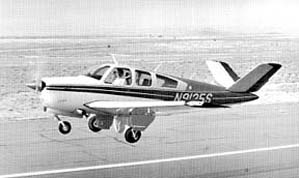
Since its introduction in the late 1940s, the Beechcraft Bonanza has enjoyed a reputation as a sweet-handling speedster ideal for the pilot wishing to fly long cross countries while hauling a reasonable load.
That said, the airplane has not been without serious troubles. In the 1980s, a string of fatal crashes was traced to failure of the signature tail surfaces. After initially denying the problem, Beechcraft developed a fix to beef up the structure, which virtually every V-tail has. These were mandated by AD.
The program of tail strengthening, combined with a campaign to find and fix any latent empennage afflictions has produced stunning results. The number of in-flight airframe breakups dropped to hearteningly low levels after years of frightening statistics safety wise, the Bonanza holds it own with most GA singles.
Although still a premium model to own and operate, both in terms of cost and speed, Bonanzas have found a loyal and enduring market.
The Background
The first V-tail Bonanzas were so ingeniously conceived that it appears they sprang from the mind of designer Ralph Harmon and others full-blown in the dim past of 1945.
At the outset, the airplane was like nothing else on the market; fast and slick and great looking. The basic format was retained for decades through fine-tuning, strengthening and bigger engine iterations, yielding a plethora of model designation.
Despite the Bonanzas later troubles with break ups, the model was by no means hastily concocted. In keeping with Beechcrafts reputation for excellence, the early Bos received the benefit of wind tunnel testing and considerable study to find ways to boost speed and increase safety, efforts that werent all that common for a GA single in the late 1940s.
This shows in the details, such as fully retractable tricycle gear, with no projecting bumps or humps as on some other aircraft and extensive use of flush-riveting. A unique fuselage design incorporates a sled-like keel arrangement and box structure to increase crashworthiness. This structure extends into the engine compartment, with the motor mounted on keel extensions, making it easy to access for most maintenance operations. Huge side windows were hinged at the top with quick release openings at the bottom to allow easy escape in an emergency. A side benefit that was blessed forever afterward by rear-seat passengers was access to cooling breezes during taxi in hot weather, a feature thats unique to the Bonanza and one that obviates the need for heavy air conditioning units, at least in temperate climates.
Straight 35s
The first so-called straight 35 model Bonanza had a 165-HP Continental engine that produced an amazing 175 MPH at cruise speed. These models are among the cheapest Bonanzas on the market these days but we would counsel potential buyers to be extremely cautious when considering one. The highest percentage of in-flight breakups of any of the V-tail Bonanzas occurred with the early straight 35s.
Unlike later models, the straight 35 lacks a shear web in the main wing spar-a design strategy undertaken to save weight. And although Beech offered a 35R wing-strengthening conversion program in 1951, there werent many takers for the expensive mod (then $6000, compared to the cost of a new C35 of only $12,990).
Only a tiny fraction of the 1500 aircraft were converted so there are probably several hundred unmodified straight 35s still flying without any major structural modification. We advise avoiding these but if youre considering one, the American Bonanza Society believes they can be operated safely if you do your homework. That means a careful pre-buy inspection and a checkout that emphasizes operating limitations. Overall, we think later model Vs are a better bet.
With the succeeding A35, Beech made important strengthening improvements, added a new wing carry-through structure and thicker wing skins and fuselage stringers. They beefed up the fuselage bulkhead at the tail attachment. On the B35, a slight power boost during takeoff of 11 HP was engineered by allowing a slightly higher RPM.
With the C35, major changes were made to the stabilizer. The chord was increased by 14.4 percent and the dihedral increased slightly in an attempt to reduce yawing. The chord increase was made by simply extending the leading edge, but leaving the front spar where it was.
This created a greater overhang forward of the spar that would figure in tail-twisting during in-flight breakups and would later be secured by a bracket after a big FAA/Beech investigation into the breakup problem.
With the E35, buyers had the option of a 225-HP Continental engine. Also, aileron trim was added for the first time and back-seat passengers got a couple inches more leg room. The magnesium flaps were replaced with aluminum ones.
In the G35 the wing was beefed up once again. And gear extension speed went up from 125 to 140 MPH, the first in a series of speed boosts that would make the landing gear an effective speed brake.
Modern Bonanzas
The H-model represents what Larry Ball in his book, The Incomparable Bonanzas, calls the beginning of a second generation of Bonanzas. The airplane got a bigger, new 240-HP powerplant which for the first time in the line offered identical takeoff and max continuous horsepower.
This was the first wet sump design for the Bonanzas, allowing oil to be carried internally rather than in a separate oil tank, thus simplifying the plumbing somewhat. Additional strengthening was also added to tail, fuselage and wings.
The major change on the J35 was a switch to a 250-HP fuel-injected engine. On the K35, the standard fuel capacity was boosted from 40 to 50 gallons, which with the 20-gallon aux tanks gave 70 gallons and moved the airplane up into the serious cross country machine it is today.
Also, an optional fifth jump seat was offered, allowing more chances to load aft of the weight-and-balance envelope. Throw it away is our advice and many owners seem to agree. Elongated, curved rear side windows were added to the N35. Horsepower went up to 260 and fuel capacity rose to 80 gallons, while the number of fuel tanks was reduced to two.
This was done by offering optional 40-gallon tanks in place of the standard 25-gallon tanks. Along with full time fuel quantity gauges provided to both tanks, fuel management was simplified and this should be regarded as a good safety feature.
The addition of new, long leading edge fuel tanks displaced wing landing lights, which in turn were moved to the nose and nose gear strut, where they remain in modern designs. Landing light bulb replacement is thus among the easiest of all GA models. Pilots concerned with tracking troublesome magnesium components might also note the ailerons were converted to aluminum, thus easing repairs and repainting somewhat.
On the used market, the P35 is one of the best values, perhaps because it got a completely redesigned instrument panel, with the famous piano keyboard switch arrangement of the early models abandoned in favor of conventional switches, albeit not always located in the best places along the lower panel eyebrow. The P-model saw a higher landing gear extension speed, up from 140 to 165 MPH.
Although the P-model was a large step forward, Beech had even bigger ideas. The S35 Bonanza came out with a 285-HP powerplant and a longer cabin with a new aft window shape like that found on Barons.
The aft bulkhead was moved back 19 inches and although this made for a comfy cabin, it planted the seed of what has become a chronic complaint among Bonanza owners: Aft CG. To address that in the S-model, Beech added 25-pound lead weight to the nose for balance.
Theoretically, the S-model was a six seater. But not really. Its just not practical to stuff passengers back there, unless theyre lightweight kids. The larger baggage compartment door is a nice plus, however. Visibility out front improved with the V35 model as a one-piece windshield was made standard. And on the V35A that followed, a bigger, swept windshield was added that allowed more space behind the instrument panel for maintenance.
A V35TC turbocharged model was added to the line for the first time, also. Normal gear-down speed went from 165 to 175 MPH. The big safety improvement on the V35Bs was addition of anti-slosh fuel cells to prevent inadvertent unporting during slips, skids and turning takeoffs, a shortcoming that had caused mishaps. (Some models carry placards advising of minimum takeoff fuel.)
Performance
Bonanzas are famous for their speed and justifiably so. With the largish engines and relatively low drag, owners report cruise reliable figures in the 150 to 175-knot range, depending on engine power.
I fly two or three big trips a year, says P35 owner Jeffery Scherer of Delavan, Wisconsin. I flight plan for 160 knots at 9000 feet. The real eye opener with regard to raw speed is the conversion to an IO-550, which a number of owners have done.
When the IO-470 the original airplane had came due for overhaul, we elected to upgrade to a 300-HP IO-550B turning a Hartzell three-blade prop, wrote Jeff Edwards of Chesterfield, Missouri, a K35 owner.
Our max cruise went from 165 knots to 185 knots TAS at 15 to 16 GPH. Rate of climb performance is equally impressive. With full fuel and single pilot on board, I frequently see over 1500 FPM after takeoff.
That speed comes at a price, however. Like Mooneys and other high performance airplanes, the Bonanza is super slick and will build speed quickly in a dive or an upset, thus requires attention from the pilot in instrument conditions or potentially moderate turbulence. Bo pilots are wisely taught the desperation tactic of lowering the gear to arrest an out-of-control dive or unusual attitude.
Balance and Harmony
Anyone who has stepped into a Bonanza from another model is immediately impressed with how we’ll the V-tail (and straight-tails) handle. The controls are silky smooth and light with nearly perfect harmony between aileron and pitch pressure.
However, the stick-forces-per-G are also light, which means that the ham-fisted pilot has less margin when yanking and banking in turbulent air. Even with the tail mods, the airframe can still be bent.
As with any high-performance airplanes, landings require good speed control. Although they can be done power off, most pilots seem to fly the approach with just a bit of throttle to improve ruddervator response and avoid sink fests. Consistent, smooth touchdowns are achievable but, more to the point, really screwing up a landing in a Bonanza is hard to do. It doesnt have the Mooneys vicious porpoise or the Saratogas tendency to plop.
What it does have is the famous Bonanza tail waggle in turbulence, which is bound to make backseaters with tender stomachs somewhat queasy. Oddly, many believe the tail waggle is unique to the V-tail, but the straight tail 33s have it to. Some owners ignore it, some say a yaw damper is required equipment.
A small amount of pressure on either rudder pedal will minimize it. They call it the Bonanza Boogie. Actually, I kind of like it. Love is blind, writes J.D. Morris of Neotsu, Ore., an M35 owner.
Weight and Balance
Apart from the tail waggle, passengers give Bonanzas high marks. For one thing, there’s plenty of shoulder and head room; the interior feels more like a 1950s Chevy than the cramped interior of the typical high-performance single. The front seats are relatively upright and comfortable but lack much forward and rearward adjustment. Leg room is adequate in both front and rear seats. By GA standards, the giant windows give unmatched airiness and visibility, especially out the rear side windows and forward through the windshield.
When carrying passengers, Bonanza pilots learn to brief them carefully on closing the cabin door. Most pilots do it themselves for if not properly secured, the door is almost certain to pop open on rotation. Its not an aerodynamic hazard to further flight but can be dangerously distracting.
The aircrafts loading Achilles heel is its relatively narrow weight-and-balance envelope, a peccadillo owners constantly bitch about. Even without big-butted passengers, its easy to load aft of the rear CG, a potentially nasty situation in any airplane but doubly so in one with controls as light as those on the Bonanza.
And on later models, as fuel burns out of the leading edge wing tanks, the center of gravity shifts farther to the rear, aggravating the situation. V-tail Bonanzas have generally stricter rear CG limits than the straight-tail models, which means that the same load will put you a lot closer to the aft limit in a V-tail.
Flying with an aft CG markedly reduces an aircrafts longitudinal stability. This means that turbulence will cause greater airspeed excursions. It also means that control wheel forces will become much lighter, making it easier for the pilot to pull too hard and overstress the airplane.
Because of the CG issue, I consider the Bonanza to be a three-person airplane. And Im damn careful to put as much weight up front as I can, wrote one owner.
Maintenance
Our inspection of service difficulty reports suggests that buyers should be alert to three main problem areas: Damaged control cables, rods, fittings, etc.; malfunctioning, out-of-order landing gear components and corrosion. The landing gear and corrosion problems can be especially expensive to repair. We noted numerous instances of broken, rusty, twisted and frayed cables, cracked ruddervator control horns and torque fittings and bent or worn push rods.
There were also quite a few reports of corrosion in the aft fuselage section-many uncovered during the thorough inspection required by Beech Aircraft Corp. as part of the tail-brace installation. (AD 87-20-02 and Beech Service Bulletin 2188 apply here. The Beech kit part is P/N 35-4016-3.) Uncovering these discrepancies can only have saved much grief later on. Corrosion was found under stringers and on ruddervator skins and ribs. This can be hugely expensive to repair.
Proper ruddervator balance has always been a critical matter on the V-tail Bonanzas, to prevent flutter, which can contribute to severe structural damage and even in-flight break-ups. The balance margin is so narrow that unbalance could-and has-resulted from repainting the ruddervators without rebalancing afterwards. Most shops know all about this but some still make the error anyway.
During the course of one inspection to comply with the Beech Service Bulletin, mechanics found they could not balance the left ruddervator per Beech specs. It was decided to strip and repaint to correct the balance.
During the stripping, a two-ounce weight came loose from the trailing edge. It had been broken loose from the screw for who knows how long. Another SDR noted that under a repainted section of the ruddervator of a V35B, a mechanic found body filler covering skin holes caused by corrosion and missing rivets.
Corrosion is often encountered with magnesium components like the ruddervators and on some Bonanzas the flaps and ailerons. But check other components as well, as the Bonanza fleet ages. Some corrosion may have been we’ll hidden.
One report on a P35 Bonanza noted heavy corrosion on the top flanges of the aft keel assemblies caused by moisture in the fiberglass laminated between the floor panel and keel flange. This was discovered after the rear floor panel was removed during the annual inspection.
Corrosion also has been found on wing spar caps and wing bolts and wing attach fittings, as the bolts were removed for a five-year inspection recommended by Beech. While on the subject of damage control, note that the FAA issued AD 91-14-13 (later superseded twice; the current AD is 95-4-3) calling for inspection of Bonanza wing spar carry-through webs for cracks on a 500-hour repetitive basis.
Beech Service Bulletin 2360, which details the inspection, was issued before the AD came out, noting there had been reports of web cracking. Beech estimated four man hours would be required for visual and dye-penetrant inspection during a routine inspection. The company can supply structural reinforcement kits if cracks are found. In some cases, cracks can simply be stop drilled.
Crankcase Bugaboo
In the past, the Continental IO- and TSIO-520 series engines have been prey to the curse of cracking crankcases, so it pays to check closely. The cracks are not a safety hazard, of course, but a possible economic one.
In years past, we have noted a relatively high incidence of cylinder cracking in Continental -520 series engines. Although we tracked this as occurring less often in Bonanzas than in Barons and Cessna 402s, Continental issued a mandatory service bulletin (M91-6) calling for inspections every 35 hours of -520-series cylinders with certain part numbers that were manufactured after 1980. By now, many of the jugs will be out of the fleet, having been replaced at overhaul.
Then again, that might not be so good, either. Since the early 1990s, TCM owners have encountered an unusually high incidence of cylinder failures related to low compression. Partly to address this issue. TCM introduced its Top Care cylinder maintenance program but thats not likely to be of much use to a would-be owner who encounters bad cylinders on a pre-buy inspection.
Ruddervator ADs
There have been several ADs in the recent past on various parts of the V-tail. 97-6-11 calls for replacement of the ruddervator differential control rod assembly if cracked or corroded and application of sealant to the control pushrods. 94-20-2 mandates repetitive inspection of fuselage bulkheads in the tail along with balancing of the ruddervator surfaces. 93-24-3 is another recurrent inspection AD, calling for inspection of the forward spar every 500 hours and replacement if cracked. 89-5-2 calls for inspection of the ruddervator control arm and replacement if cracks are found… and thats just the ADs from the last decade. Make sure you do a thorough AD check on any Bonanza considered for purchase.
The tail isn’t the only target, of course. Other significant recent ADs include 97-26-17, ultrasonic inspection of the engine crank and replacement if defects are found, and 97-18-2, inspection of the prop.
Gear Accidents
V-tail Bonanza pilots forget to lower the gear or yank it up unintentionally in astounding numbers. In the last six-year interval we checked, we counted no fewer than 188 instances during a period when 668 accidents involving Bonanzas occurred. Thats 28 percent of all accidents during that period. Once again, the harm is mostly to the pocketbook and insurance rates as a whole.
Why is this so? The most logical theory is that the gear/flap switch arrangement on earlier Bonanzas-which is the reverse of most common retractables-is the culprit. Its easy to grab the wrong switch in the heat of clearing the runway or on a touch and go.
The best counsel a new Bonanza pilot can heed is to leave the flaps down until the aircraft is back at the tiedown area or at least clear of the runway, where it can be calmly sorted out. Or, make sure you recite this is the flaps, not the gear before moving the switch. And don’t expect the squat switch to save your bacon; all too often it doesnt.
Even without the pilot contributing to the problem, the gear often enough will collapse of its own accord, thanks to mechanical problems. We tallied 79 gear collapses and 16 gear mechanical failures of other types-gear wouldnt come down, wouldnt go up, etc.
We also tallied a number of gear collapses occurring after the aircraft encountered an electrical failure. Every new Bonanza trainee should be instructed in how to crank the gear down manually. This is not at all a difficult procedure but it needs to be done correctly to avoid this sort of SDR comment: Total electric failure. Manually put gear down. Gear collapsed on rollout.
Fatal Break Ups
The six years of accident records we looked at suggest that the V-tail Bonanzas penchant for in-flight airframe failures has been largely tamed. Although we hesitate to announce final break-up figures since there were so many unexplained fatal crashes (16), we were able to identify only five fatal breakups in the study period.
In two of the six years we could find no fatal breakups at all recorded, and in three of those years, only one each. This represents a big improvement in a daunting record of past break-ups totaling 240 V-tails since 1947. Its difficult to tell whether the tail brace kits, or the mass empennage inspection and upgrade have improved the situation most. Wed guess both together did the job.
Incidentally, in some of the recent break-ups the tail-strengthening kit had been installed, we are told, so that alone appears not to be infallible protection. And we spotted two cases where serious structural damage had occurred in flight, attributed to tail flutter, but the pilots landed safely.
Fuel (mis)Management
Bonanzas suffer a fairly high incidence of fuel mismanagement, based on the accident reports. Time and again pilots ran one tank dry while they still had fuel in another. Typical comment: Engine quit on final. Landed short of runway. Fuel selector on empty tank. Other tanks full. As we noted earlier, it wasnt until the N35 model that a pilot could see how much fuel was in each tank all the time without switching.