











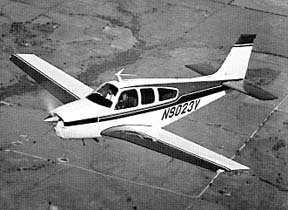
The 33 Bonanza is one of the few piston singles to survive the great general aviation slump of the 1980s. The quintessential doctor/lawyer single, it even outlived the previous archetype, the Model 35 V-tail Bonanza.
Owners love its flying qualities, performance, comfort and sturdy construction. However, they also have some words on the high cost of parts and maintenance, typical of Beech aircraft. Also, there are a few things to be careful of when operating a Bonanza.
History
Beech practically invented the modern retractable single just after WWII, when it introduced the original Bonanza. There was really no competition for it for years: in the late 1940s Cessna was putting out airplanes like the 120, 140 and 170, and Piper was building tube-and-fabric airplanes like the Cub and Super Cruiser. By comparison, the Bonanza looked like a starship, if you’ll pardon the pun.
But after a dozen years, the Bonanza was facing some real opposition. Airplanes like Pipers Comanche 250 offered comparable performance and styling for a lot less money – about two-thirds the price in the late 1950s.
Beech responded by introducing a new airplane to compete directly with the Comanche, while retaining the upmarket Bonanza for those who still wanted the real thing. It was dubbed the Model 33 Debonair, and made its debut in 1960.
The new airplane was clearly based on the Bonanza, with the same wing, fuselage and landing gear. However, by this time the Bonanza had built up a powerful brand image. The company did not want to hurt sales of its flagship by cheapening it, and so made considerable changes to the 33 to clearly distinguish it from its V-tailed sibling.
Most notable was the tail. The 35s distinctive V-tail was replaced by a well-proportioned conventional empennage. Less in evidence was the change in powerplant: The Bonanzas 250 HP Continental IO-470-C was replaced by a 225 HP IO-470-J. Gross weight was somewhat less.
To reduce the price down to the vicinity of the Comanche, Beech also removed much of the equipment that came with a typical Bonanza. Little things, like paint, vertical speed and turn-and-bank indicators and sun visors. The result was a rather Spartan airplane, but one that did indeed sell for about what the competition was charging.
That same strategy has been used repeatedly through the years to boost sales and cut down on the effects of sticker shock. Mooney did it in the early 1980s with the 201 Lean Machine, and Piper followed suit a few years later with the Cadet.
The Debonair didnt exactly take the market by storm. Some 233 were built that first year, compared to over 800 Comanche 250s and 400 35 Bonanzas. Still, the airplane proved popular enough for Beech to continue with it. (It did not seem to hurt Bonanza sales: Beech had been building about 400 Bonanzas a year for a couple of years running.)
Changes were made almost immediately. The A33 1961 brought with it some additional equipment, extra windows, a hat shelf and a boost in gross weight, from 2900 to 3000 pounds-still less than the Bonanza. Production amounted to 154.
The B33 came out the following year, with a new panel and a different variant of the Continental IO-470, the K. It remained in production through 1964. Total production: 426.
The C33 in 1965 got another boost in gross weight, but this was more than offset by an increase in empty weight. There were several other minor improvements as well. The earlier Debonairs had a bench seat in back. This was replaced by individual seats, and a fifth seat (practically useless) was offered as an option. Larger rear windows were made available, and the storage shelf was made larger. The C33 remained in production through 1967. 306 were built.
1966 saw a secondary model come out, the C33A. The big news here was the engine: The C33A was fitted with the V35 Bonanzas Continental 285 HP IO-520 B/BA, making it for all intents and purposes a straight-tailed Bonanza. The C33A was built for two years, 1966 and 1967, with a total production run of 179.
1968 was a big year for Beech. The six-place 36 Bonanza was introduced, and Beech made official what everybody already knew: that the Debonair was really just a Bonanza with a different tail and less elaborate equipment.
For some reason there was no D33. The 1968 model was the E33 Bonanza, and the company continued producing the 225 HP version as we’ll as the 285 HP E33A model. The only real difference, other than the name change, was a new windshield. There were 116 E33s produced and 85 E33As.
Of particular note was another 33 variant produced during this time, the E33C, which has the distinction of being certified for aerobatics. (Were constantly getting calls asking about this airplane.) Major differences between the -C and the -A are a strengthened tail, positive-pressure fuel pump and a cabin door that can be jettisoned. Those wanting one will have to look hard, because aerobatic Bonanzas are rather rare. Total production of the E33C for the two years they were made amounted to 25. There was also an F33C, total production five aircraft. These airplanes command a hefty premium on the used marketplace. Expect to pay at least $25,000 extra for the privilege of flying beyond the limits of the Utility category.
The F33, last of the 225 HP Bonanza 33s, was introduced in 1970 and lasted only a year, with 20 built. It differed by having larger rear windows and more baggage space. Its sibling, the 285 HP F33A, was the model that would continue in production up to the present.
There was one last variant, the G33, which was built in 1972 and 1973, with a total production run of 49. It had a 260 HP Continental IO-470N.
Things settled down after the introduction of the F33A, and other than improving the avionics suite, Beech has decided to leave we’ll enough alone. Good thing, too: the F33A is a fine aircraft. Nearly 1800 had been built when production stopped in 1995. The price, of course, climbed steadily. In 1970, a new, average equipped F33A could be had for a tick under $50,000. By the mid-90s, that had climbed to over $325,000.
Which Bonanza?
The original Debonair was definitely a downmarket airplane compared to the 35 Bonanza. Over the years, though, the Debonair was given ever more lavish equipment and more power, and it evolved into what is, in effect, a 35 Bonanza with a straight tail. Still, for a long time there was a perception that the V-tail was better, and it carried a premium. That is no longer true.
For example, a 1970 V35B sold new with average equipment for a little over $54,000, while the F33A (same engine and airframe, different tail) went for about 10 percent less. Those same two airplanes have now reversed roles. The 1970 V35B average retail is several thousand dollars less than the F33A.
The success of the 33 Bonanza is due in no small part to the 35 Bonanzas in-flight breakup problems, which dogged the V-tail through the early 1980s and eventually led to its demise. There was an AD to strengthen the tail, and it worked well; nevertheless, the V-tails reputation was damaged to the point that it was pulled from production.
Looking again at the competition, the Bonanza has held its value better, though its advantage is slipping. The 1970 Piper Comanche 260 brings about $10,000 less than a 1970 F33A and is about on par with the less-powerful 225 HP F33.
Performance and handling
This is where Bonanzas really shine. They have some of the best-harmonized controls in the business. Pilots love the handling, but are also quick to point out that its important to stay ahead of the airplane, particularly in IFR conditions. Unfortunately, staid, solid handling typically translates into good suitability as an instrument platform.
Thats not to say the Bonanza isn’t a good instrument airplane. It is. But it really helps to have a good autopilot. It is not a trim it and forget it airplane, says one. As much as I enjoy the airplane, I would not enjoy it nearly as much without the autopilot.
Typical of single-engine retracts with high wing loading, the stalls are sharp but not that difficult to recover from with proper technique. Landings are easy, provided the pilot watches power settings and airspeed closely.
The 33 is fast enough to make it one of the better piston singles for cross-country flights. Pilots of the 225 HP airplanes typically flight plan for 150 knots and 12 GPH. The more powerful 33s are faster, of course, and use more fuel. Figure 165-172 knots on 13-15 GPH for a 285 HP model. Climb performance also is relatively good.
The airplanes are rather slippery; lower the nose, and theyll pick up speed quite readily. Early Debonairs have a relatively low maximum gear speed: 122 knots. However, the 154-knot limit on B33 and later models helps a bit during descents and pattern work. Maximum flap speed is a low 104 knots on early Debonairs, but it was raised to 113 knots on the C33 and to 123 knots on the F33A. Flap levers in airplanes built in 1979 and later have a detent for an approach setting (15 degrees) that can be selected up to 154 knots.
Comfort and loading
The cabin of the 33 is quite comfortable, with appointments of typically high Beech quality. Later 33s offered a fifth seat that, like most, is really more a decoration that something a person would want to sit on.
Rear-seat passengers in the 33 often complain about the airplanes tendency to Dutch roll in turbulence, and many pilots have had yaw dampers fitted. Some pilots say there’s no problem, and there’s no doubt that the 35 is more prone to tail-wagging than the 33.
One characteristic of the 33 (and 35) Bonanzas is that the CG will shift as fuel is burned. Its important to do a weight and balance calculation for both ends of the flight. The airplane does not like aft CGs, and in the words of one pilot gets squirrely if the CG isn’t kept forward. Its easy to get out of the aft CG limit, too.
The cockpit is we’ll laid out, though it does have its quirks. Visibility is quite good. The unusual Beech control yoke arrangement blocks part of the panel, but for the most part it shows good design. The early models were far better than those of contemporary aircraft.
Systems
Overall, the Bonanzas have robust, we’ll designed systems. The gear, for example, is a very sturdy electro-mechanical design that is very strong and far less prone to trouble than some other types. Flaps are electric.
There are some oddities, though, that we must mention. When Beech was deciding where to place the controls in the cockpit all those decades ago, it had the remarkable bad luck to put things backwards relative to the rest of the industry. In particular, the designers put the gear control to the right of the engine controls, and the flap switch to the left. There’s nothing wrong with this arrangement, but the simple fact that everybody else did it the other way around has led to more than one accident. Beech eventually switched the locations, but in a classic example of Murphys Law the now-standard location caused confusion amongst Beech pilots whod gotten used to the old style controls. The pilot has got to pay attention, particularly when transitioning from one airplane to another. (Beech did offer an automatic gear-extension system called Magic Hand, but its not too common.)
Early models had an odd fuel system, too. When the optional extended-range tanks were installed, fuel drawn from the auxiliaries goes to the fuel pressure regulator, and the excess is returned to the system…but it drains into the left main tank. If there isn’t enough room, it gets vented overboard, so its important to run the left main down before switching to the auxiliaries. The older 33s also had a fuel gauges that would read only one tank at a time.
Later models inherited the 35 Bonanzas fuel system, which has none of these foibles.
Maintenance
Maintenance is costly on Bonanzas, and its very important to find a mechanic that knows the airplane well. Weve heard of many instances of poor maintenance that came about simply because of lack of familiarity with the airplane. One pilot noted that maintenance has cost about $60 per hour, exclusive of engine reserve.
One bugaboo that has always haunted Beech owners is the cost of parts. Paying high parts prices simply goes with the territory when flying a Bonanza. In that respect, its rather like an expensive luxury car; once you get into this league, you have to expect to pay a lot. Example: a prop spinner back plate from Beech costs an astonishing $2000. Fortunately, parts are readily available.
There have been several type-specific ADs to hit the 33 in recent years, some minor, some not so. The most recent, 97-14-15, is no big deal: it calls for making sure the door handles lock properly. But the prior couple are much more severe: 95-4-3 mandates repetitive inspections of the front wing spar carry-through frame, along with repairs and reinforcements if cracks are found. And 93-24-3 calls for repetitive inspections of the rudder forward spar, and repairs if cracks are found. 89-5-2 covers the elevator (inspect, replace if cracked).
Other significant ADs of recent vintage cover the engine (97-26-17, ultrasonic inspection of the crankshaft, replace if found defective; 86-13-4, pressure check the cylinders every 50 hours until replacement) and prop (97-18-2, repetitive inspections).
Mods
A number of useful modifications are available for the 33 Bonanza, including TKS weeping-wing ice protection, Precise Flight speed brakes, various aerodynamic cleanups from Smith Speed Conversions, electric rudder trim, long-range tanks, and turbochargers from TurboPlus and Rayjay.
One of the more notable mods is an engine swap to Continentals liquid-cooled IO-550 Voyager engine, available from Beryl DShannon and Colemill. DShannon can also provide vortex generators, which are a very worthwhile mod for any airplane.
Owners group
The American Bonanza Society (www.bonanza.org) is one of the best groups around. Members receive an informative newsletter and can attend service and proficiency clinics offered at about a dozen locations each year. The address is The American Bonanza Society, Mid-Continent Airport P.O. Box 12888, Wichita, KS 67277; (316) 945-6913.
Owner comments
I own a 1965 Beech 35-C33 purchased in 1989. I wanted an airplane that was reasonably fast, reliable, had a good safety record and was cost-efficient to own. I had been part owner/club member in several different aircraft including Cessna 150, 172, 182, & 310; Piper Comanche, Cherokee, & Arrow. I longed for a Beech A36, but this time I wanted to be sole owner, so I chose the Debbie. It took almost two years of looking to find one. In six and a half years of ownership, I have put around 1200 hours on the airframe. It has been an excellent compromise of performance verses cost.
Most of my flying involves trips between Milwaukee and southern Indiana or northern Wisconsin. I make 4 or 5 long trips a year to Maine, Washington D.C., Houston and Florida. With those kind of missions, it made sense to sacrifice a little speed and payload of the A36 for the Debbie. On a typical trip between Milwaukee and Bloomington, Ind., Id only save about 10 minutes in an A36 (depending on the mood of Chicago Center) verses the increase in initial investment and higher maintenance and fuel costs. I flight plan for 150 knots and 15 GPH including taxi, take-off and climb, with a little cushion built in. Mine has a 225 HP IO-470K, and the 15 GPH is a little on the high side of book value. Loading is quite adequate, and although the small baggage door can be a pain, the room is ample, especially if the two back seats are removed. I had an old full size Olds wagon, and when I take my daughter back and forth from college, if I could get the load into the wagon, it would fit into the Debbie. CG is not usually a problem, although as in all Bonanzas, the CG moves aft as fuel is burned off, so one must do a calculation for takeoff and landing. As the CG gets close to maximum aft, the handling does get a little squirrely, with a tendency to pitch up at lower airspeeds (e.g. landing).
Shortly after purchase, (which did include a pre-purchase inspection) she began to burn oil. The engine had about 1000 hours on it at purchase and coming back from Omaha over eastern Iowa it threw a rod. Fortunately, I was seven miles from an airport at 7000 feet and made the field. The book was right- it does glide better with the prop in high pitch (low RPM)! I was fortunate enough to find a Penn-Yan rebuilt engine. It has performed flawlessly through the last 950-plus hours, except for replacing one jug at about 300 hours because of a leaking exhaust seat. It burns about two quarts for every oil change (25-30 hours). The prop was rebuilt at the time of engine change and again recently after five years time in service. (McCauley two blade – $1600)
Insurance runs about $1000-1200 per year. Annuals have been $1500-2000 depending on the work done. Beware of old fuel cells that will need replacing. You can see telltale blue fuel stains around the underside of the main spar. They are expensive ($2000 each plus installation – which is difficult). When one leaks, the other soon will, too.
I have had the panel redone about 4 years ago and updated the old large gyros, installed a Stormscope and an S-Tec autopilot. I cant say enough about the autopilot – it has been trouble-free since installation. Recently, it has just been painted and had new interior installed – Central Aviation in Watertown, Wisc. – truly remarkable craftsmen & women. It looks and flies like new!