











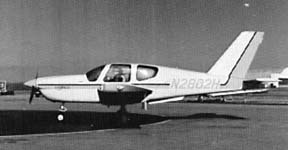
We don’t get to see much French hardware in this country anymore, but those of us who remember such wonders as the Citroen automobiles with their hydraulic suspensions, or the old Renault 16, the interior of which could be stripped out in minutes without tools, will also recall that the French have their own distinctive way of doing things. The French approach to engineering is elegant or odd, depending on your point of view.
The SOCATA Caribbean series, when it was introduced in this country in the mid-1980s, was the embodiment of that unique way of doing things. Markedly different from anything wed ever seen, the French imports had a lot to offer, and they even managed to successfully buck the downward spiral that all but killed off American light aircraft production.
What the Caribbean series really brought us, though, was a fresh look at the design of light aircraft. They use the same engines as others, and perform about the same, as well. But there’s considerable innovation here: a high degree of parts interchangeability, superior ergonomics in some respects, and simple, efficient construction. Whereas the typical Cessna or Piper-even a mid-1980s model-clearly shows its late-1950s roots, the Caribbean series looks far more modern.
The entire series has a sleek, exotic look both inside and out. Reportedly, SOCATA farmed out the TB series interior to an industrial designer with a lot of experience laying out the cockpits of exotic high-performance automobiles. Most pilots agree that the gentleman earned his fee. Good human engineering combines with maintainability.
The company
Technically, the Tampico was not made by Aerospatiale, but by SOCATA, or The Societ de Construction dAvions de Tourisme et dAffaires, a subsidiary of the largely French-government-owned aerospace conglomerate Aerospatiale.
SOCATA is the successor to Morane-Saulnier, the original developer of the Rallye or MS 880, and Potez, which took over the Morane-Saulnier facilities when the former went bankrupt. These companies all ended up as part of Sud Aviation, one of several nationalized aerospace companies, which became part of Aerospatiale in 1970.
History
The Caribbean series consists of three basic airplanes, the TB9 Tampico, for the low-and-slow trainer (read Piper Warrior) market; the TB10 Tobago (aimed at the Archer and its ilk), and the retractable TB20 Trinidad. There are several submodels, such as the TB21TC turbocharged retractable and the TB200 Tobago XL. All look similar, because the airframes are, in fact, virtually identical.
Though they didnt arrive here until the mid-1980s, Aerospatiale announced the TB Caribbean series at the 1977 Paris Air Show. The TB10 Tobago was the first model certified, in 1979. The new series was developed to replace the modestly successful STOL Rallye series. Rallyes didnt make it over here, but theyre quite commonly seen in Europe. The bad experience the company had with the Rallye in North America seems to have affected the introduction of the Caribbean series here: It was very tentative at first.
After a TB10 was taken on a market survey tour of cities in Canada and the U.S. in the fall of 1980, several plans were made and abandoned. In 1984, a distributor was appointed to import and market the line, starting with the retractable TB20 Trinidad. This arrangement flopped in short order. Finally, the company took control of its destiny in 1986, establishing a U.S. subsidiary based in Grand Prairie, Texas, alongside Aerospatiales well-established helicopter operations.
In a way, the timing couldnt have been worse. The mid-1980s were the time when most American lightplane manufacturers were finally admitting defeat and shutting down their production lines. Still, the company managed to sign on enough dealers and sell enough airplanes to keep the venture going.
The production scheme was a bit cockeyed for the first several years. The U.S. components of the airframe, such as the engine, were built here and shipped to France. Each airplane was constructed there, test-flown, disassembled, shipped to the U.S. and put back together again (a few were ferried across, however). Starting with the TB9 Tampico in 1992, a production facility opened here.
SOCATA doesnt actually assign model years, but the last airplanes listed were delivered in 1995. Average equipped prices for the original TB10s was $75,000. That figure more than tripled by the end of the airplanes ten-year run, to almost $234,000.
Airframe
The TB airframe is a clever design that blends low-slung, elegant lines with simplicity that stems primarily from designing for efficient manufacturing and trying to minimize the parts count. A parallel design objective was to simplify maintenance and reduce operating and life cycle costs.
There is near-total airframe commonality across the series. Except for minor differences in such elements as wing dihedral and trim surfaces, the structure and aerodynamic surfaces are common to the entire series. The fuselage is built up from several large sec-tions: a metal semi-monocoque tub forms the lower half of the cabin section up to the door sills; the top half of the cabin structure is fabricated from aluminum sheet, with distinctive gull-wing doors and large windows; the tail cone is a monocoque structure.
The wings are almost constant-section, with some variation in leading-edge shape and twist at the outer sections for aerodynamic control at the stall. Chord is narrow. Relative to wing span (32.5 feet), the ailerons appear stubby. Most of the trailing edge is taken up by the single-slotted flaps.
The spar is milled as opposed to being built-up from smaller com-ponents; flush riveting is used in the wing skins. The empennage bears a family resemblance to the Rallye. A generous vertical fin and large rudder are mounted forward of the tail cone, with the stabilator placed aft of the vertical tail.
Ventral fins, or strakes, are located on the lower fuselage just aft of the baggage bay. These directional control aids help meet spin recovery requirements. Control surfaces are actuated by push-pull tubes, which is unusual for this category. Trim is cable-actuated.
Aerospatiale sales literature points out that 80 percent of systems and components other than the airframe are manufactured in the United States. This includes major items such as the engine and electrical systems, avionics, wheels and brakes.
The TB10s 180-HP O-360-A1AD Lycoming is mated to a constant-speed Hartzell propeller.
A fuel-injected model of the Tobago was introduced in 1993. The TB200 Tobago XL is powered by Lycomings IO-360-A1B6 version of the widely-used four-cylinder engine, which is rated at 200 HP.
For about $6,000 more, buyers got a slight improvement in climb rate, especially in high density altitude conditions, and a marginal increase in cruise speed (roughly three knots) in exchange for less payload and a gallon or two more fuel burned per hour. Operating and limiting weights remain the same as the TB10. The TB200 has held its value better over the years than TB10s of comparable vintage.
There have been minor changes to the TB10 over time, most in response to field service problems or airworthiness directives. However, earlier versions are restricted by a maximum landing weight of 2,407 pounds (this was increased to 2,535 on later models), as we’ll as maximum baggage bay load of 100 pounds, later raised to 143 pounds. It is worth carefully reviewing the data for each aircraft, since there also are five-pound variations in maximum operating weight (2,530 vs. 2,535 pounds). In 1989 the electrical system was changed to 28-volt capacity. In that year the company also started using polyurethane paints in place of the acrylic exterior finish.
Marketplace
The TB10 goes head-to-head with several notable aircraft in the 180-HP, four-place, fixed-gear niche: the AGAC Tiger, Piper Archer, Cessna 177 Cardinal and Beech Sundowner.
Unfortunately, its tough to compare relative values for this group, since some had already gone out of production when the Tobago was being built. For those airplanes that were being produced at the time, the Tobago has held its value somewhat better: An average-equipped 1992 Tobago has retained 74 percent of its new value; the Archer has kept 64 percent, while the AGAC Tiger has retained only 60 percent.
The speed king of the group, not surprisingly, is the Tiger. But the TB10 is second (75 percent cruise is 127 knots versus 139 for the Tiger, with the Archer third at 125). In an unrealistic measure of payload with full fuel, the Tobago is tied for second with the Tiger; the Archer wins. Its unrealistic because its based on basic empty weight rather than equipped weight.
In most other measures, such as service ceiling, rate of climb and required field length the airplanes are all close enough in performance to call them even, especially in the hands of the average pilot.
The Tobago easily wins the elbow and shoulder room contest with its 50-inch-wide cabin. And, surprisingly (because it pulls that wide fuselage through the air), it has the greatest range at 635 NM with the Arrow and Sundowner tied for second at 565 NM.
One pilot who has owned two TB10s wrote that despite the quirky engineering, the French havebuilt by far, the most comfortable, stable, we’ll handling and attractive planes in their class. He adds that the TB10 is farsuperior in ergonomicsto anything coming out of Wichita or Vero Beach.
Loading
Tobagos are equipped with as much as 200 pounds in avionics and accessories, although the av-erage is closer to 150 pounds. Even the most plush can legally accommodate three 170-pounders with full fuel, although one owner dubs his a very good two-person cross-country plane.