











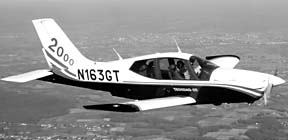
The French have always done things a little differently. Sometimes a lot differently, as is evident in the Aerospatiale line of piston singles.
While European manufacturers have not proven a powerhouse of GA manufacturing, Aerospatiale has achieved an enduring if not overwhelming presence with its single-engine trainers and cruisers.
The TB-20 Trinidad, especially, looks trim and sleek with a sports-car like interior one aviation writer once described as a Cherokee done over by Club Med. These airplanes also have gull-wing doors, lots of class and, coming soon, the option of diesel powerplants.
Sales of the TB-20 have been lukewarm in the U.S., with ups and downs since the model was introduced at the Paris airshow in 1977. There are some 270 TB-20/21 registered in the U.S.
Significantly, however, as U.S. manufacturers were shutting down their plants in reaction to weak market conditions, Socata kept at it, delivering a steady trickle of airplanes to what it sees as a world market.
Model History
The Trinidad is the top of the line of a small family (five) of single-engine aircraft developed and built by Socata in Tarbes, France. Socata is the general aviation division of the government-owned aerospace conglomerate, Aerospatiale.
The so-called Caribbean line of aircraft includes the TB-9 Tampico and -10 Tobago, fixed-gear singles of 160 and 180 HP and the 250-HP, retractable-gear TB-20 Trinidad and -21-TC turbocharged Trinidad. In this regard, the French have largely duplicated the American marketing strategy of a model for every price and usage strata.
The models share a common fuselage, wing and empennage, which has obvious advantages in production economies, something U.S. airframers haven’t always done.
In practice, this means that a batch of fuselages and flying surfaces can be built and kept on the shelf until orders need to be filled. It also means that for the Caribbean series, no distinction is drawn between the airframes: The two variants co-exist within the same run of serial numbers.
To date, the total worldwide TB-20/21 population tops out at about 730 airframes worldwide. After its promo appearance at the Paris Air Show in 1977, the TB-20 was awarded French type certification in December 1981. The first Trinidad arrived in the U.S. during the summer of 1983, with FAA type approval the following year. The turbocharged TB-21 gained FAA certification in March of 1986.
Acceptance of these models can best be described as mixed. The French had been in the U.S. before with the Rallye and had not done we’ll with it in a market that still supported volume sales.
After a couple of failed efforts to introduce the TB line, Socata established its own operation just outside of Dallas, Texas. Aerospatiale General Aviation (AGA) shared facilities with Aerospatiale Helicopter Corp. in Grand Prairie. This facility was phased out in favor of a single distrbutor in Florida and as of this writing, Socata has a corporate presence at North Perry Airport in Pembroke Pines, Florida. (954-893-1400.)
TB-20 models built between 1977 and 2000 are so-called “Generation One” aircraft and most of those already in the field are of this vintage. In early 2000, Socata introduced the “Generation Two” or GT line, with upgrades to the original aircraft design.
The GTs have essentially the same airframe, controls and powerplant as the originals but they have a modified carbon-fiber based cockpit roof which increases headroom and cabin volume, thus addressing complaints from taller pilots. Other minor changes have been introduced. In 1990, starting with serial number 950, maximum landing weight was increased to 3086 pounds. Unfortunately, structural modifications were made to the landing gear attach points and they are not retrofittable to earlier models.
At the same time, the electrical system was changed from 14 to 28 volts. A change to a higher-speed starter motor followed. To its credit, the detail and systems changes Aerospatiale/ Socata has made to the design are almost completely the result of customer experience. Also to its credit, according to reader feedback, the company has been responsive to customer requests for assistance, although one former owner who contacted us complained of weak parts support.
Construction
The relatively simple, monocoque fuselage has a comparatively low parts count compared to like aircraft. According to the company, it takes about 600 man hours to construct a Trinidad.
This is lower than, for instance, the hours required to build a Mooney or Bonanza airframe. Most of the cabin is fabricated from reinforced glass fiber which sits on top of the load-bearing structure, the fuselage tub.
Flight controls are actuated by push rods rather than the more typical cables, which gives a positive – albeit a bit heavy – control feel similar to Mooney models. Since much of the wing trailing edge is occupied by the flaps, the ailerons are short span. It’s a simple, yet sleek design.
A prominent distinction is the vertical stabilizer, which is located forward of the horizontal, all-flying tail or stabilator. Both control surfaces have trim tabs. Pitch trim is via an anti-servo tab.
The rudder trim tab is an additional surface appended to the rudder that looks like an afterthought. The main landing gear is a trailing link design that favors pilots who occasionally botch landings; it soaks up the bumps well.
For power, the TB-20 uses the Lycoming IO-540-C4D5D version rated at a conservative 250 HP. The turbocharged TB-21TC combines the AB1AD version of the same powerplant, also rated at 250 HP, with a variable wastegate-controller Garrett AiResearch turbocharger.
Recommended TBO for both is 2000 hours, which is a plus. Also a plus is that none of these engines was affected by the massive recall of 300 HP and over Lycomings in the fall of 2002.
But that doesn’t mean TB-20 owners have an easy time of it. As with any large engine, overhaul costs are relatively high. In a phenomenon unique in recent experience, there’s actually good news about the cost of operating the turbocharged engine.
When we covered the Trinidad some years ago, our sources quoted an average overhaul cost for the turbocharged engine of a whopping $30,000. To quote one facility manager we talked to, “…it is a very expensive engine to overhaul, and we don’t see many of them.” Since then, average cost for overhaul of the turbo engine actually dropped, to about $23,000, due in large part to intense competition in the cylinder field. As of early 2003, overhaul costs have again inched up, hovering around the $29,000 mark. The normally aspirated variant costs about $20,000 to overhaul, variable with cylinder choice.
Cabin Comfort, Loading
Another feature that distinguishes the TB series is the top-hinged, gull-wing cabin doors. These make access to any seat quite simple, with a minimum of fumbling and clambering. The cockpit/cabin is modern looking and is we’ll organized.