











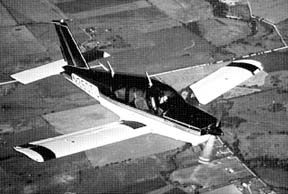
The French have always had a way of going about engineering that is rather different from what Americans are used to, and the line of Aerospatiale singles is no exception. They have gull-wing doors, unusual instrument panels, and ergonomics that are far superior to some of the competition. Perhaps their most important difference, though, is that they were first introduced in the U.S. at about the same time our factories were shutting down production. And unlike other product introductions (or reintroductions) such as the Tiger or the mid-80s Pipers, they managed to hang on through several lean years.
History
The Trinidad is the top of the line of a small family (four) of single-engine aircraft developed and built by SOCATA of Tarbes, France called the Caribbean series. SOCATA is the general aviation division of the government-owned aerospace conglomerate, Aerospatiale. The family includes the TB-9 Tampico and -10 Tobago, fixed-gear singles of 160 and 180 HP, and the 250-HP, retractable-gear TB-20 Trinidad and -21TC turbocharged Trinidad. The models share a common fuselage, wing and empennage. Commonality aids production scheduling. For instance, a batch of fuselages and flying surfaces can be built. What model a particular ship set becomes can be adjusted according to what is ordered from the field. This means that for the Caribbean series, no distinction is drawn between the airframes: The two variants coexist within the same run of serial numbers. To date, 1750-odd have been built.
The series was introduced at the Paris Air Show in 1977. The TB-20 was awarded French approval in December 1981. The first Trinidad in the United States arrived in the late summer of 1983. FAA certification came the next year. The TB-21 gained FAA certification in March 1986.
Because of the companys poor experience trying to sell the almost-STOL Rallye here in the 1970s, it approached the North American market very cautiously. After a couple of failed efforts to introduce the TB line, SOCATA established its own operation just outside of Dallas, Texas. Aerospatiale General Aviation (AGA) shared facilities with Aerospatiale Helicopter Corp. in Grand Prairie. At present, SOCATAs presence in the U.S. consists of a distributor in Florida.
Though SOCATA doesnt assign model years per se, the last aircraft listed in the price guides date from 1995. As that time, SOCATA started work on a follow-on series, the MS (for Morane Saulnier) line, which is to use an unusual Renault-developed piston powerplant that burns jet fuel and have airframes derived from the Caribbean series. Its unknown whether we’ll ever see any of these on this side of the Atlantic.
Weight evolution
The first TB-20s had a maximum takeoff weight of 2943 pounds. This was increased to 3086 pounds in 1984, along with a maximum ramp weight of 3097 pounds, but the maximum landing weight remained 2943. This has been a concern to some pilots, even though it is a typical condition for many piston aircraft, particularly twins.
In 1990, starting with serial number 950, maximum landing weight was increased to 3086 pounds. Unfortunately, structural modifications were made to the landing gear attach points and they are not retrofittable to earlier models. At the same time, the electrical system was changed from 14 to 28 volts. A change to a higher-speed starter motor followed.
To its credit, the detail and systems changes Aerospatiale/Socata has made to the design are almost completely the result of customer experience. Also to its credit, according to reader feedback, the company has been responsive to customer requests for assistance.
Construction
The relatively simple, monocoque fuselage has a comparatively low parts count. According to the company, it takes about 600 man hours to construct a Trinidad. This is far lower than, for instance, the man hours required to build a Mooney or Bonanza airframe. Most of the cabin is fabricated from reinforced glass fiber. This sits on top of the load-bearing structure, the fuselage tub. The cabin doors (yes, there are two) are cut out of the cabin structure. The door sill is the top of the tub, so there is a minimum number of holes in the load-bearing structure. The largest is the relatively small, triangular baggage bay access door on the port side of the fuselage.
The wing, too, is a relatively simple, straightforward structure. Dihedral is fairly pronounced. The spar is milled rather than built-up. The constant-chord wing has a relatively small area of 128.1 square feet (compared to 181 for the F33A, 174.7 on the Mooneys, and 170 on the Arrow). At the low end of the speed range, this is made up for by large, long-span, slotted flaps. Stall speed clean and in landing configuration are comparatively high at 70 and 50 KIAS, compared to 64 and 52 for the Bonanza and 61 and 56 for the Mooney. The low wing area means a loading of just over 24 lb/sq.ft. in the later models, which makes for a solid ride in turbulence. The wings are further simplified by being of constant-chord design, far easier to build than a tapered planform.
Flight controls are actuated by push rods rather than the more typical cables, which gives a positive, albeit a bit heavy, control feel. Since much of the wing trailing edge is occupied by the flaps, the ailerons are relatively short span.
It is a simple, yet sleek design. A prominent distinction is the vertical stabilizer, which is located forward of the horizontal, all-flying tail or stabilator. Both control surfaces have trim tabs. Pitch trim is an anti-servo tab. The rudder trim tab is an additional surface appended to the rudder that looks like an afterthought. The main landing gear is trailing link.
Powerplant
The Lycoming IO-540 powerplant, which is in widespread use in a number of variants and airframes, continues in production. The C4D5D version used in the TB-20 is rated at a conservative 250 HP.
The turbocharged TB-21TC combines the AB1AD version of the same powerplant, also rated at 250 HP, with a variable wastegate-controller Garrett AiResearch turbocharger. Recommended TBO for both is 2000 hours. The 2000-hour TBO is a plus. But as with any large engine, overhaul costs are relatively high.
In a phenomenon unique in recent experience, there’s actually good news about the cost of operating the turbocharged engine. When we covered the Trinidad some years ago, our sources quoted an average overhaul cost for the turbocharged engine of a whopping $30,000. To quote one facility manager we talked to, …it is a very expensive engine to overhaul, and we don’t see many of them.
A few years ago, the average cost for overhaul of the turbo engine actually dropped, to about $23,000; its now back up to about $26,000. The normally aspirated variant costs $18,500 to overhaul.
Cabin comfort, loading
Another feature that distinguishes the TB series is the top-hinged, gull-wing cabin doors. These make access to any seat quite simple, with a minimum of fumbling and clambering. The cockpit/cabin is very modern looking and is we’ll organized. It is 50 inches wide, the most expansive in its class. In fact, it is one inch wider than the Piper PA-32 family of wide singles.
The Trinidad can accommodate up to five people. There are individual bucket seats up front. Up to three (small) passengers can be carried on the rear bench seat when the optional center lap belts are installed. The airplane is quite comfortable for four, though tall individuals have noted tight headroom, particularly in the rear. The seats include an adjustable lumbar support.
To go with its notable spaciousness and comfort, the Trinidad can carry a comparatively hefty payload. It is almost a full-tanks and full-seats airplane, which is unusual for singles and light twins. It also has a generous CG range to permit loading flexibility. At an average equipped weight of 1990 pounds, payload with full fuel (86.2 gallons usable/517.2 pounds) is 589.8 pounds. That equals 3.5 170-pounders. To put things in perspective, its full-fuel payload exceeds that of any other four-place single. It is close to the Lance/Saratoga SP and even beats the A36 and B36TC Bonanzas. Only the Cessna 210 surpasses its payload capability, but with less comfort.
Cockpit design
Visibility from all seats is excellent. The windshield and side windows wrap up into the roof line. Also, the windshield extends down alongside the panel, meaning that the pilot can actually see down and forward a bit. Further, the seating position is high up, and the window sills are low.
Ergonomically, the cockpit is we’ll organized. The panel is an unusual modular arrangement with the right-side gauges mounted at an angle to face the pilot squarely. The console has a trim wheel cleverly placed direcly under the pilots hand when its on the throttle; trim adjustments during final approach are very easy.
Models built before 1987 have the fuel selector mounted to the left of and just below the pilots yoke. This arrangement was the subject of an AD (more about this later). The three panel modules can be released quickly and tilted back for maintenance access. Additional access panels are provided in the glare shield. There are a lot of pockets and crannies for manuals, charts and odd pieces of gear.
The interior is we’ll thought out. The biggest drawback is the relatively small, odd-shaped baggage door. It is hinged at the bottom and when fully opened projects. Care must be taken when loading the baggage bay. Access to the baggage bay for bulkier items than can fit through the door can be gained from inside the cabin. The rear seat back can be folded down or removed.
Operations
There is nothing peculiar about operations. From pre- to post-flight, the airplane is quite straightforward.
Inspection of the engine compartment is difficult because a number of fasteners must be unscrewed. Then, the one piece cowl has to be put in a safe place while the inspection is performed so that a wind gust doesnt send it sailing down the ramp. Many operators probably wont bother frequently enough to catch the odd deteriorating hose, loose connection or nesting bird before they create a problem.
Once a pilot gets accustomed to some of the different information presentations, such as the vertical temp and pressure gauges and the two-part electrical switches (one of which actuates the electric turn and bank – a trap for the unwary), it is an easy airplane to operate.
Normal takeoffs call for 10 degrees of flap. Standard flap control is an electric switch that permits settings anywhere from up to full-down (40 degrees). It must be monitored during operation to get the right setting. Many Trinidads are fitted with the optional pre-select switch (up, 10 and 40 degrees). In maximum performance takeoffs, and climbing at best angle, the forward view is filled with cowling. Rate of climb at Vy of 95 KIAS is 1,250 FPM. Critical speeds are Vne, 187 KIAS; Va (maneuvering) 129 KIAS; Vlo (gear operating) 129 KIAS; and Vfe (maximum flap extended) 103 KIAS. So descent management takes some thought (and possible negotiation with ATC).
One concern with both models should be shock cooling the engine in descent, unless you decide to extend the gear at the top of descent, when indicated airspeed probably will be below Vlo.
Control response is good. Highest effort is in roll. The stubby ailerons and the push rod control mean you have to work a bit harder to get large displacement. It probably is most noticeable to someone used to flying a Bonanza, a Bellanca or a later-model 210. But it isn’t a drawback. Pitch and yaw control effort is lower. So it is more an issue of balance, or control harmony, than hard work.
The good trade-off is that the airplane, thanks also in part to its comparatively high wing loading, handles turbulence well. It also displays good manners during instrument flight.
Performance
The spaciousness and comfort of the Trinidad comes at the cost of cruise performance, but it still is respectable. According to factory figures, 75 percent power at 8000 feet nets a true airspeed of 159 knots. Endurance, with 45-minute reserve, is 5.65 hours. At the same altitude, 65 percent generates 149 knots and a bladder-busting 6.4 hours endurance.
The turbocharged version does not perform quite as we’ll at lower altitudes, like most turbo models. The crossover point comes at about 12,000 feet. At its maximum operating altitude of 25,000 feet, 75 percent power generates a true airspeed of 187 knots and endurance of 4.5 hours; 65 percent power produces 169 knots and 6.2 hours.
Handling
Slow-flight manners are good. While the stall speeds are marginally higher than with other singles, the stall is very mild. The typical result is more a high rate of sink rather than a pronounced break. The flight controls are fully functional right through the stall. Intentionally cross-controlling near the stall or even in it (hardly a recommended practice) produces sink rather than a snap.
Pitch change with initial flap extension is minimal. It is more pronounced when full flaps are selected, particularly at the higher end of the allowable speed range. Saving full flaps until the landing is assured means adjusting trim or accepting high pitch forces down to the flare, at which point the up trim has to be put back in. Full flaps generate a lot of drag, which means either accepting a steeper approach (good for obstacle clearance) or a partial-power approach.
Low-speed technique is rewarded with a bit of practice and establishing a procedure that works best for you. The low-speed performance is exceptional, once you are fully transitioned to the airplane. In this respect, it shows a bit of the Rallye heritage.
Landings, except for the most highly botched and abusive, can be done repeatedly with grace. Lightly loaded, with just the pilot aboard it takes a bit more attention, because c.g. is forward. But its manners (and willingness to forgive) are very good.
Airworthiness directives
Most of the other changes made to the TBs are reflected by service bulletins and Airworthiness Directives. Some 23 ADs have been issued on the TB-20 and -21. Most of these are blanket ADs affecting many different aircraft: paper induction air filters, Bendix ignition switches, Bendix magneto impulse couplings, Hartzell propellers and Airborne vacuum pumps. Several blanket ADs cover various aspects of Lycoming engines (e.g. 91-14-22, calling for inspection of the crank and associated parts for corrosion following a prop strike or at overhaul).
There are a few ADs targeted at the Aerospatiale airplanes. An AD issued in 1990 requires a one-time inspection of oil coolers on all TB series airplanes for cracks and what the text merely calls distortions. If anything is amiss, the oil cooler must be replaced.
The AD on the fuel system that was mentioned earlier was issued to deal with a condition that resulted in fuel starvation in a few instances. In the original design, fuel lines run from the tanks forward and up to the panel-mounted fuel selector. Two conditions could occur: Fuel could drain to the low point, causing the fuel pump to cavitate. The original Dukes fuel boost pump is lubricated by fuel. Dry lines resulted in its failure. Or, vapor lock could occur, blocking normal fuel flow. The fix for the original system is to replace the boost pump with a wet-or-dry Weldon pump and to install a check valve in the line to preclude draining. In 1987 and later models, the fuel selector has been relocated to the center console. Also, it has been modified so that it is not necessary to pass through off when changing tanks.
Three accidents have been attributed to fuel starvation. One example of why a thorough inspection and records search is essential when buying an aircraft is the Trinidad that crashed on short final due to engine stoppage. The fuel system AD had not been complied with.
Three ADs have been issued on the horizontal tail; two of them require repetitive inspections. One requires replacement of the elevator trim tab control attachment. The second requires repetitive (every 100 hours) inspection of the stabilator actuator rod end assembly and attach fittings. It is also necessary to replace the rod ends if play or loose fittings are found. Replacing the original assembly with a modified one eliminates the requirement for repetitive inspection.
The third AD requires 100-hour inspections of the fuselage frame at the horizontal stabilizer hinge and attach fittings. If cracks are found, the fuselage frame must be replaced. The airplane then can be flown without the inspection for another 700 hours. Or, instead, a modified frame can be installed to preclude any further inspections.
Another repetitive AD affects the ailerons. The skin and balance weight attach rivets must be inspected every 100 hours. Substantial cracking requires aileron replacement. An improved part eliminates the inspection requirement.
For aircraft through serial number 1052, the fuselage frame at the nose landing gear and aft engine mount location must be inspected for cracks after 1,500 hours and every 500 hours thereafter. Socata has developed a kit to fix the potential problem. If it is installed, the periodic inspection is not required.
Possible interference between the main landing gear and supporting structure must be inspected for under another AD. If no signs of interference are found, modification must still be made within 100 hours.
The two ADs above suggest that the landing gear has been subject to a great deal more abuse than the designers anticipated.
Another AD requires inspection of the battery tray and surrounding structure for electrolyte leakage and subsequent corrosion. It also requires modification of the battery box to eliminate leaks.
The most recent AD, issued in 1998, covers possible corrosion of the front seat belt anchors, due to leaks in the cabin doors. This has appeared in past reviews of SDRs on TB-series aircraft.
Two significant ADs, also from 1998 and covering the fixed-gear TB series airplanes, don’t apply to the Trinidad. Both of these concerned airframe cracks, one related to the landing gear support structure, the other addressing the wings rear attach points.
Value
Apparently the marketplace does not value the Trinidad as highly as its owners at the moment. As the price history chart shows, average retail values are stable or dropping slightly. This is in contrast to some other designs, which are appreciating steadily. The reasons for this are not clear, though we suspect it may have something to do with the currently weak dollar, which makes factory parts more expensive. Realistically, though, most of the parts that are likely to wear out (vacuum pumps, starters, and the like) are American, anyway.
The design is maturing, with the factory responding we’ll to weaknesses that have been made apparent through operating experience. Support appears to be good, and better than many other designs on the market. Aerospatiale appears to be settling into the North American marketplace, and concern about being orphaned is minimal.
Owner Comments
I own a 1989 TB-20, which I purchased new. I completed my IFR training in it, and must comment on how stable the airplane is. The high wing loading enables it to take the bumps well.