









In the 1980s, Honda ran a TV commercial with a persuasive salesman whose main goal in life was to sell cars, but he got stuck selling a car that sells itself. Google it—you’ll grin.
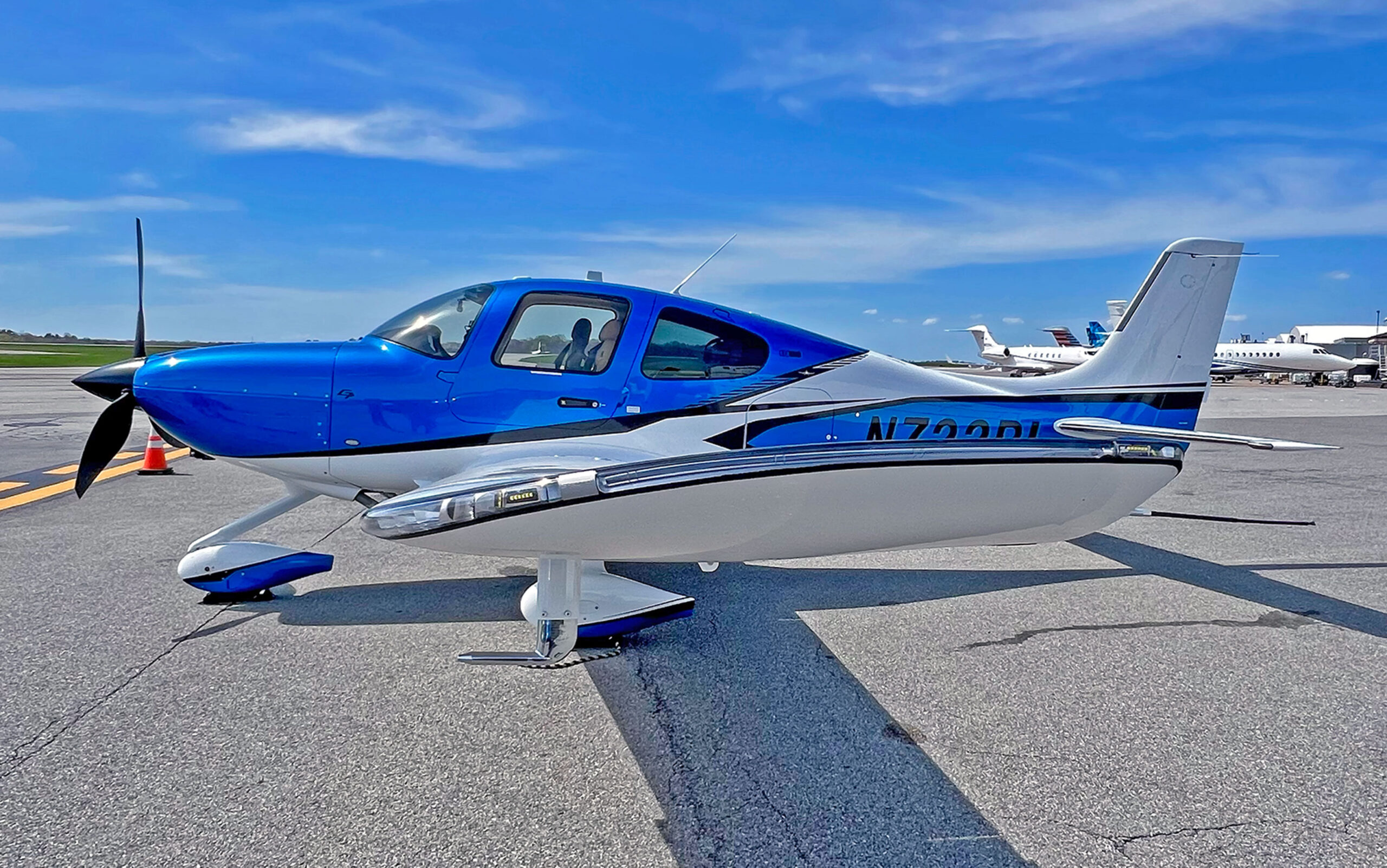
And in the current world of million-dollar piston singles and qualified buyers, I suspect it’ll be pretty easy to sell the 2025 Cirrus SR22 G7+, especially to nervous spouses and family members who don’t want to think about helplessly riding along in a good airplane with a bad pilot.
Along with luxury automotive-like cabin styling and a slick ramp appeal, the CAPS whole-airplane parachute and now Garmin’s Emergency Autoland that Cirrus calls Safe Return, the latest G7+ is a pretty convincing package for pilots and pax. It also sets a new standard for flagship piston singles with another layer of safety.

Jet primer
Since some Cirrus SF50 Vision Jet buyers move up from SR22 piston models, Cirrus redesigned the cockpit of the SR22 G7 last year to ease the transition. This includes the Garmin Perspective Touch+ avionics with larger 14-inch dual screens that can be configured for split-screen viewing. As large and crisp as these displays are, I wondered why they aren’t touchscreen and suspect buyers will, too. But they don’t need it.

Data entry is much easier than it is on the mechanical FMS keypad controller in previous Perspective models—replaced by dual touchscreen controllers—for access to every function on the PFD and MFD. If you’ve used Garmin’s GTN-series navigators, the feature set, icons and control logic in the touch controllers should be familiar. While there’s a lot going on in the G7+ flight deck, the menu structure within the touch controllers is refreshingly shallow and a huge improvement over earlier Perspective systems.
In its continuous quest to perfect the ergos, Cirrus reworked the bolster panel (the row of rocker switches below the PFD) and added a scroll wheel for running through the onscreen checklist. The pitot heat rocker switch has been removed from the bolster panel in favor of Cirrus’ Smart Pitot Heat system, which automatically comes on (under engine power) when the temperature is below -5° C. Worth mentioning is that this automated pitot heat (and airframe anti-ice protection when equipped) is a requirement for the Safe Return Autoland because while the system picks the best route to avoid weather, there’s no guarantee that the plane won’t fly through icy clouds.

Mimicking a high-end sports sedan, the cabin experience in the new G7+ is pleasing (and even better in the Xi Design Studio personalization trim models) and I think Cirrus did a good job of improving creature comforts, including the climate control panel that sits just below a storage compartment with USB ports (stick your phone in there) below the autopilot controller. Cabin ventilation and cooling from the air conditioning seemed to work perfectly on an 82-degree day with a sun-splashed cabin, plus the eyeball air vents seemed perfectly placed at every seat in the cabin. While the airplane has traditional magnetos and a Both/Left/Right/Off panel control switch, there’s a keyless engine start button—like in the jet.
The G7+ also launches the new version of Cirrus IQ PRO, which enables automatic database updates through Garmin’s GDL 60 PlaneSync connected aircraft management system. You dial into the airplane with the IQ PRO app to check fuel and other synoptics, plus manage inspections and maintenance, review flight summaries and also access an approach score to see how well you flew the last approach to landing. The basic version of the app allows you to remotely check the health of the aircraft by viewing fluid levels, battery status and flight hours on your phone or on the My Hangar online portal.

Runway awareness
Given the heightened awareness for runway incursions, in my view one of the more significant enhancements to the SR22’s cockpit is the Garmin ROA, for Runway Occupancy Awareness. Type in your taxi instructions and along with taxiway routing and 3D SafeTaxi, ROA analyzes aircraft GPS and ADS-B traffic information relevant to the airport’s runways and taxiways. It’s an impressive tool that most certainly can help you avoid a runway incursion or collision. ROA provides visual caution and warning annunciations on the PFD and highlights the runway yellow or red, depending on the level of threat, using Garmin’s Synthetic Vision Technology (SVT). It also provides similar caution and warning annunciations on the 3D SafeTaxi map displayed simultaneously on the multifunction window. Both visual and aural alerts are provided based on the potential hazard, ranging from no immediate collision hazard to a warning level alert where a collision risk could occur within 15 seconds. It’s quite interactive.
Out of the chocks at New York’s busy Westchester County Airport, the system clearly identified traffic that was landing, taking off, stopped or taxiing on our runway. It’s also useful for showing traffic (with tail number) on approach to the runway or the runway that crosses. I think it’s a huge boost in traffic awareness, plus how the heck can you get lost at big airports if you follow the magenta line that it draws on the screens?

Flying it
To call the new SR22 automated (or pilot proof) is an understatement. The fuel shutoff and selector control are now under a liftable cover placed just aft of the throttle. New for the G7 series is automatic fuel tank switching (92 gallons is usable), which based on fuel flow switches tanks after every 5 gallons is consumed. Open the fuel selector access door and the system goes into manual mode, where you can switch tanks the old-fashioned way. Good utilities are onscreen engine, fuel and electrical system synoptic pages. As one example, you can eyeball the schematic to verify which tank the engine is drawing from. The electrical system pictorial is a snapshot of the main and essential bus so you can see precise voltage and current draw. The G7+ has an EarthX lithium battery that saves nearly 20 pounds from the old lead acid one, and the electrical synoptic diagram shows the battery’s stats, including temperature.

The SR22 G7+ flown for this report is powered by the 310-HP Continental normally aspirated IO-550N. It has a 1328-pound gross weight and a published maximum range (at 55 percent power) of 1169 nautical miles. Cirrus also offers the turbocharged 315-HP SR22T, with a maximum service altitude of 25,000 feet and 1246-pound useful load. There are three trims: Base, Premium (Carbon and Platinum) and the limited-production Special Edition Arrivée.
I tip my cap to Cirrus for setting what I think is a high standard in both exterior paint finishes and interior styling. Then again, buyers expect it just as they do when spending big for high-end vehicles. There are airbag seat belts, 60/40 rear seating for five, powered headset jacks, lighted USB-C ports at each passenger seat, illuminated cup holders and storage areas and perhaps best of all, the redesigned interior offers more legroom. There’s built-in oxygen with a redesigned overhead O2 manifold that interfaces directly with the avionics.

The G7+ flies like every other later-model SR22, but the new G7 series adds wing flap airspeed protection that monitors the speed so you don’t move the flaps out of the envelope. The maximum extension speed for 50 percent flaps (used for takeoff) is 150 knots and full flaps extension is 110 knots. For speeds, Vne is 205 knots and maneuvering speed at the 3600-pound gross weight is 140 knots. For the turbo SR22T G7+, the specs call for a 213-knot true maximum cruising speed. For the normally aspirated model, plan on 183 knots true.
Even in the normally aspirated model, the 74-knot rotation speed comes up quickly and you simultaneously feed in the power and right rudder and the airplane flies itself off the pavement. Initial climb is 90 knots; retract the flaps and at 600 feet AGL the CAPS parachute is available at speeds below 140 knots. Cruise climb is 110 to 120 knots. For landing, fly it on speed every time. Best glide speed at gross weight is 92 knots, and a normal approach with full flaps is generally flown at 80 to 85 knots.

Safe return
When Garmin revealed its Collier Trophy award-winning Autoland tech for the Piper M600 turboprop six years ago, everyone wondered what the next application would be. After all, only a small percentage of lucky pilots might afford a new turbine. Soon Autoland became standard in the Cirrus Vision Jet, Daher TBM940 and other high-end turbines. But what if Autoland was installed in piston models flown by non-professional pilots? Could it help sell more airplanes?
For pistons, the obstacle was the required autothrottle because in an Autoland activation, the pilot presumably can’t control engine power. But Garmin’s Autothrottle does and while it’s easy enough to build on to a FADEC-controlled turbine engine, a deeply integrated autothrottle is a challenge for traditional Continental and Lycoming powerplants.
Cirrus calls the automatic throttle in the Safe Return-equipped G7+ an “emergency autothrottle” because in a nutshell, that’s what it is. Servo motors interfaced with the throttle and mixture controls take care of engine operation during a Safe Return activation. It’s even easier to pull off in a Cirrus, which has a single-lever throttle and a separate cable attached to the propeller governor that adjusts the governor oil pressure to increase propeller pitch to maintain engine RPM.
Interesting is this isn’t the first application of a utilitarian servo throttle in a Cirrus. It’s used in the SF50 Vision jet (which now has a fully integrated autothrottle) because during CAPS deployment, the thrust lever needs to be retarded for the proper pitch and airspeed configuration.
The Safe Return can be activated manually with the button in the cabin overhead or automatically if the Perspective Touch+ avionics doesn’t get a response from the pilot through expected system interaction. If the airplane is up high, the autopilot’s emergency descent feature will first descend the plane lower in case the pilot is hypoxic. If the pilot still doesn’t respond, Safe Return takes over and it can be disconnected at any time with the autopilot disconnect switch.
When Safe Return is activated, the software algorithm is looking for longer and wider runways (not necessarily the nearest) while also considering terrain and weather. During my demo on a gusty day, the system initially maintained 145 knots, eventually throttled back and deployed the flaps to 50 percent (it flies a steep 95-knot approach with half flaps in case the airframe has ice), advanced the mixture to rich and set up and landed at Stewart International Airport in New York. Just as Cirrus’ Ivy McIver briefed before activation, it carried the approach farther down the 11,817-foot pavement, holding around 90 knots before bleeding off the speed, retarding the throttle to idle and settling into a flare and firm touchdown just left of the centerline, correcting for the wind. There’s automatic braking, of course, and the system shuts down the engine and retracts the flaps.
Safe Return is looking for runways with a GPS approach with vertical guidance. What if the runway is closed? Safe Return copies the NOTAMs and won’t take you there. It also won’t fly through heavy weather radar returns, though it’s perfectly capable of flying in IMC. Remember, it’s the GFC 700 autopilot that’s doing the flying. Also, if given the choice of an airport in Class D or Class B airspace, it’ll pick the one in the D space to avoid shutting down major fields because it declares an emergency, stops on the runway and shuts down.
There’s a 10-second grace period where the system warns that Safe Return will be activated in case someone or something in the cabin inadvertently hits the button. You’ll need to reconfigure the avionics by entering the desired flight plan, setting the altimeter and other items because Safe Return resets everything.

The best Cirrus yet?
Having flown every generation of the Cirrus SR since 1998, I climbed out of the G7+ (it’s fully certified) thinking it is. Cirrus’ Ivy McIver does, too, but she’s rightfully more impressed with the Cirrus approach to quality training and that includes Embark—a complimentary transition program for every pilot new to any Cirrus.
As for Safe Return, it’s yet another safety net in an airplane that already attracts buyers reassured by the CAPS parachute. Who knows how many Safe Return Autoland activations there will be, but given the number of planes Cirrus cranks out each year, you can bet there will be some button pushes.