











By now, the aviation press has shilled the use supplemental oxygen to the point that pilots are practically breathing the stuff recreationally. Climbing above 4000 feet? Good grief, you’ll need oxygen. Feeling tired? Here, have some oxygen. Night touch-and-go practice? Pass the cannula, please.
We like breathing as much as the next guy but this has gotten ridiculous. Whats even more ridiculous is how inconvenient the use of oxygen still is. Cannulas are bulky and uncomfortable and they clutter up the cockpit. Theyre also wasteful of oxygen that can be both difficult to find and expensive to buy when you can find it.
The aviation oxygen trade-small as it is-is addressing these issues with more efficient delivery systems and more comfortable oxygen appliances. The day may yet come when a foray into the flight levels wont require the plumbing skill of an ICU nurse.
In this report, we’ll examine two new oxygen devices, one a mechanical conserver and another a cannula system that marries to your headset with the intent of offering a single, quick-donning unit.
There are two ways to reduce the cost of oxygen: use less of it or buy the stuff more cheaply. (Or both.) If you have a hangar, you can buy welders oxygen and charge your aircraft supply for a fraction of what youd pay an FBO. But youre still stuck if you need a refill on the outbound trip, thus neutralizing the investment in bottles and transfillers.
Thats where oxygen conservers come in. Conservers reduce oxygen flow by sensing when the user is about to inhale, instantly flowing or pulsing a bolus of oxygen to a mask or cannula. The flow is shut off when the user exhales, saving oxygen.
This is a tricky bit of engineering because it requires balancing small differential pressures created by inhalation against larger pressures from the oxygen supply. A couple of conservers we reviewed in the August, 2002 issue of Aviation Consumer do the sensing and conserving electronically. Now, Precise Flight-a well-known maker of aircraft oxygen systems-has introduced a new conserver that does the pulsing mechanically, with no electronics.
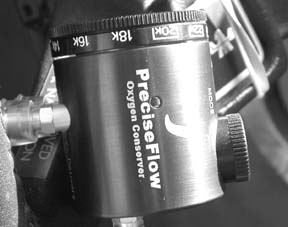
As shown in the photos, the PreciseFlow conserver consists of a small milled aluminum cylinder-its 2 1/8 inch long by 1 inches in diameter. Its size and shape are largely determined by the need to accommodate an internal chamber large enough to pool an oxygen bolus of sufficient size. The cylinder has three nipples, one for inlet oxygen from the supply, one for output oxygen to the user and a third for sensing inhalation.
On top of the cylinder, there’s an adjustable knob for various altitudes and a two-position switch for selecting either constant flow or conserver mode. Currently, according to Precise Flight, the PreciseFlow is suitable only for portable bottles, which operate at low pressures. Built-in systems typically operate at two to three times the output pressure-up to 70 PSI-of a portable system and these will require another model, which Precise Flights Scott Philiben told us the company plans to offer. The PreciseFlow kit costs $380 and includes a dual lumen cannula and mask, plus the necessary tubing and fittings. The device is also equipped with a snap clip, for attaching it to a belt or clothing.
The operating principle of the PreciseFlow is simple enough. It senses inhalation through one of the cannula tubes plugged into the sensing nipple then opens the oxygen flow briefly to allow a pulse of oxygen through the delivery side of the cannula. It has a small, finely balanced diaphragm and valve arrangement that plays supply pressure against the lower pressure of the inhalation cycle. When inhalation ends, the valve shuts off oxygen flow.
The gross volume of flow is set by rotating the knob to the desired altitude. This rotates a disc inside the PreciseFlow with a series of orifices, each calibrated to a specific flow rate.
Flying It
We tried the PreciseFlow on a couple of flights at 13,000 feet, measuring its performance with a Nonin pulse oximeter. We did encounter some problems, albeit not due to the device itself. Our portable oxygen bottle had both a leaky fitting and apparently output at a pressure too high for the PreciseFlow. The supply line kept popping off the nipple unless we opened the mode selector to constant flow or selected an altitude we’ll above our cruising altitude, thus flowing more oxygen than we needed.
This strategy yielded oxygen saturations in the high 80 to low 90-percent range. Then we noticed something curious. By barely cracking the valve on the supply bottle to reduce the outflow pressure, the hose stayed put at any flow setting and our oxygen saturation levels improved substantially, remaining in the low 90s to near the mid-90s.