










Your 45th birthday is a memory. You caught yourself squinting at the gauges on a recent approach to minimums. The near-vision test on your last medical? You passed it-barely. You have presbyopia, or old eyes. This term probably made sense 120 years ago, when 40 was old, but the term persists. Its the result of the loss of elasticity in the crystalline lens in the eye, which allows us to zoom focus on near objects. Because its the lens getting stiffer, not the focusing muscles getting weak, no amount of exercise will resolve the problem. The problem gets worse with age, no matter what you do.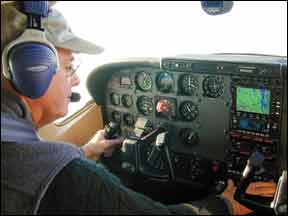
Progressive Thinking
To better understand your options for progressive lenes, take a look at your vision in general. If youre nearsighted and wearing distance-only glasses, you may have excellent near vision without your glasses and be more comfortable without glasses for reading than with progressives. That works fine at home, but not in the cockpit, so progressives are still a necessity.
If youre a pilot who wears contacts for distance and has difficulty reading, your options are limited. Bifocal contacts don’t give the acuity you need, and monovision (one eye for distance and one for near) is not allowed by the FAA. You must use either single-vision reading glasses over the contacts or progressives over the contacts. In these cases, you may simply be better off using progressive lenses alone for flying.
Have you had LASIK or cataract surgery? Custom digital (high definition) lenses may be the best choice because these surgeries sometimes induce or fail to correct higher order aberrations. These digital aberrations are not correctable with ordinary progressives, but they are correctable with wavefront technology.
don’t hesitate to interview a prospective doctor to see if he is experienced with progressive lens designs and if he has experience with pilots. The right optometrist is the one who will best serve your needs. Be prepared with a complete history of eye care, including past prescriptions, and any current eyewear. Make careful measurements of your cockpit environment. Its important to know the distances between your face and your charts, instruments and avionics. A photo of your flight deck is useful. If you fly several aircraft, photograph and measure them all.
Knowing the distances and widths of the areas of visual demand is essential in selecting the proper lens design and power. If you habitually hold your approach plates 16 inches from your face, the progressive strength would be different than if it were 20 or 14 inches.
Tips for Different Eyes
If youve never needed glasses until you hit 40-something, and then only for reading, you’ll have some adjustment transitioning to glasses. The good news is, you don’t need glasses all the time (only when you want to see, I tell my patients) and you have the largest choice in lens designs. Make sure that you choose a frame size that will allow at least 18 mm from the fitting point to the bottom of the frame. This becomes increasingly important as you go from age, say, 42 to 58 and the reading power increases.
The adjustment for nearsighted pilots (can see better at near than in the distance) depends on how nearsighted you are, and if you have astigmatism. If your prescription is relatively low (-1.00 to -2.50) with little or no astigmatism, you have a lot of choices. Just make sure there is enough vertical room in the frame. If you are more nearsighted, say above -4.00, you want to keep the frame size smaller and use either polycarbonate or high-index plastic (high index means less lens material to accomplish the desired change in power). Rimless frames may work, but the edge thickness becomes more visible; don’t try if you are over -6.00.
If youre farsighted, again, a lot depends on the magnitude of your prescription. Luckily, you’ll adjust to progressives quickly, because you cant see we’ll without them. Up to around +2.00 in the distance, there’s little limitation. Above +3.00, frame size matters, you don’t want rimless frames at all (the center of the lens