











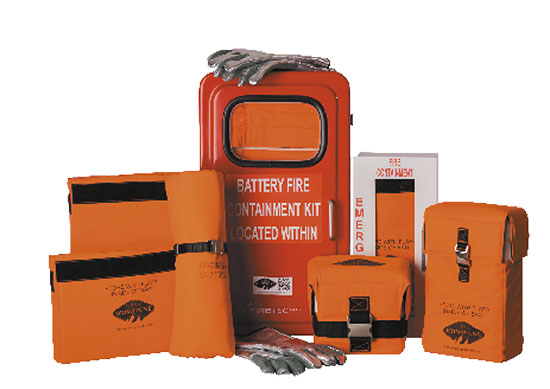
Cabin fires can have catastrophic outcomes, and while rare, the risk can be greater when you factor in all of the lithium-ion-powered portable devices that get carried on the aircraft.
The battery-powered stuff in my Rockwell cabin includes a SPOTx tracker, a Garmin GDL 52 portable ADS-B receiver, a Garmin inReach Mini satcomm, an iPad Mini, an iPhone, a Flight Outfitters flashlight, an Aithre CO detector, the Aithre power vault and a Sporty’s Flight Gear mega 20,000 mAh power vault. Throw an eBike on for extra flame.
If you’re paranoid about any of this gear overheating to the point of blazing, there are plenty of aircraft-specific fire containment accessories for an added layer of protection. Here’s a starting point for tailoring a system for your needs.
NEW BATTERY TECH 101
Over the past century, there has been a lot of R&D to make batteries better—a needed progress. To this point, nickel cadmium rechargeable batteries were eventually replaced with nickel-metal hydride, which have been replaced by lithium-ion, lithium iron and lithium-ion polymer batteries.
Lithium chemistry has changed both portable and ship batteries for low- and high-end applications. Nanophosphate lithium-ion and lithium iron phosphate cells offer power advantages without the thermal runaway issues plaguing the consumer electronics sector. Lithiums are 70 to 80 percent lighter than lead-acid and nickel cadmium, have a 10,000-charge cycle life (versus 350 for a lead acid battery) and won’t corrode, sulphate, freeze or boil. For a better installation, they can be mounted in any position (except inverted), have a low self-discharge rate (good for winter months when you might fly less) and they have wider operating temperatures and a higher starting voltage while the engine is cranking (for faster starts). But they also have some issues to know about—including a discharge voltage that’s very constant, essentially delivering a steep drop-off at total discharge.
True Blue Power and EnergyX are two manufacturers who have been leading the charge on new tech for aviation batteries, both for certified and experimental markets. We’ll look at them in a separate battery market scan.
THE BURN
As for failsafe, consider that lithium batteries used in aircraft may be designed to manage events that might trigger a cascading thermal runaway and ultimate smoke show. The FAA has mandated (through the TSO and STC process) that lithium-based aircraft batteries have a Battery Management System (BMS). On the higher end, True Blue Power’s batteries have built-in failsafe in the event of an internal short circuit and thermal runaway by directing the white, electrolyte vapor outside the aircraft and away from cabin occupants.
For the most part, lithium-ion batteries are safe and reliable, except when a cell (inside the battery pack) suffers an event that changes the cell’s chemistry and ultimately generates an inordinate amount of heat. Cascading thermal runaway occurs when the heat and gases of the first cell in a chain get so high that they cause the cell beside it to begin to overheat. This causes a chain reaction, causing the battery pack to soar to temperatures in excess of 1100 degrees F. The risk is real. Remember the run of Samsung phones that overheated? Need more proof? There are many YouTube videos showing electric cars involved in thermal runaway fires. Fire departments report that an electric car fire requires a tremendous amount of water to extinguish compared to traditional fossil fuel cars. And while the probability of thermal runaway is very low, the outcome if it happened in an aircraft while airborne—or post-crash—is dire.

Consider that lithium-ion thermal runaway sparks a different circumstance than a plain-vanilla electrical fire in a typically equipped aircraft. Essentially, the fire can’t be put out with the limited fire extinguishers carried in many aircraft. The FAA has conducted tests and has been studying this problem for the past two decades. In its test 747 airframe, the FAA found that the aircraft’s halon fire suppression system was not able to put out a lithium-ion battery fire. It began tracking thermal runaway fires in U.S.-registered aircraft over 23 years ago and found there were 274 thermal runaway incidents in U.S. commercial air transportation during a 23-year period, with 76 percent of these incidents reported since 2015. Thermal runaways in GA aircraft are not tracked. And in the cabin, it’s not just about flame.
As the batteries enter thermal runaway, with the heat building, materials containing the battery will also burn. In a typical cascading thermal runaway; with battery cell pressure building, each cell may explode, leading to a cascading effect of cell explosions. Smoke, heat and fire are the first problems caused by thermal runaway; however, the device containing the batteries (think laptop computer) will begin to melt—and there’s a lot of plastics in computers. During thermal runaway, the batteries will off-gas lithium metals and toxic fumes that you certainly don’t want to inhale.
THE VOLATILE 18650 CELLS
There are many different types of lithium-ion battery cells used to create a battery pack. The 18650 battery cell is commonly used to construct battery packs for consumer electronic devices, and known to be the most volatile cells manufactured to date. Any manufacturing anomalies or quality control issues could impact the volatility of a cell, potentially causing it to enter into a thermal runaway condition. Poor-quality 18650 batteries (due to their lack of protection) can cause their internal pressure to suddenly increase and explode when overcharged.
Overall, the safety record of high-quality lithium-ion batteries is actually quite good. However, poor- quality cells are prone to an internal short-circuit during use, which can cause thermal runaway. Physical damage to a cell (like driving a nail through it) may cause a thermal runaway. Part of the challenges with 18650 battery cells is they’re used in a variety of consumer products from laptops to cameras to power tools, and there are disreputable companies making fakes and counterfeits of a higher-quality branded product. Choose your cabin power banks carefully, and it could be worth it to spend more on certain power supplies.
Doug Ranly, director of aviation products and marketing at Sporty’s, said the company has been following thermal runaway issues for quite a while. “Our Flight Gear power vault products are made with high-quality lithium-ion cells and have built-in heat protection measures. Working closely with our manufacturing partner, we ensure that the highest levels of quality control and inspections are maintained,” he said. To date, there have been no reported thermal runaway events with these power vaults. The Flight Gear power vaults are designed to shut themselves down when the battery gets too hot when being charged. The microprocessor inside the battery pack constantly monitors the battery health for any issues, and in the event of a problem, the battery vault will shut down until the issue is resolved. The Flight Gear battery protects against temperature fluctuation, over-charge, over-discharge, over-voltage, over-current and short circuits.
STANDOUT PRODUCTS

There are a number of vendors manufacturing smoke masks and goggles, including Brimstone and Aerox. The Aerox smoke glasses with tear shield alone are worth stashing in a map pocket or next to the fire extinguisher.
There are also fire containment products (from reputable companies) to keep in the cockpit in case of battery thermal runaway. And while there are inexpensive FCBs (fire containment bags) that can be bought on Amazon from $15 to $500, I put some of them in the risk category of buying a used as-is parachute on eBay.

But many of the standards for high-quality FCBs come from Underwriter Laboratories, with its UL-5800 testing and certification (a standard for containment bags meant to contain personal electronic devices such as laptops, phones and tablets that undergo thermal runaway). These high-quality fire-rated products manufactured to ISO 2001 standards provide traceability of all materials, plus each FCB has a unique serial number to provide traceability. There’s also a minimum 10-year shelf life, high-quality filters to allow toxic gases to be vented safely, plus in some cases even vendor liability insurance covering loss of aircraft and life in the event of a failure of its FCB. There’s good reason for the high-standard construction (and high prices).
FCBs that protect against lithium-ion battery thermal runaway are designed to contain the fire, heat and most of the toxic smoke, while keeping the outside of the FCB relatively cool. Most of these FCBs have venting technology to ensure that the high-pressure gases do not compromise the containment device, exploding burning hot metals, fire and gases into the aircraft’s cabin.
Brimstone Fire Protection (www.BrimstoneFireProtection.com) has been developing a series of FCBs and smoke containment bags specifically designed for lithium-ion batteries since 2016. Its HD (heavy duty) bags have been tested to internal temperatures of 1600 degrees F (flame side), with the temperature on the cold side of the containment bag leveling off at 240 degrees F.
“There are no containment regulations officially on the FAA books, but our materials for each product are FAA compliant per 14 CFR 25. We have third-party 12-second vertical burn test certificates to verify our product claims,” said Lee Hershberger, president of Brimstone Fire Prevention.
Brimstone has four sizes of fire prevention bags—essentially, small, medium, large and extra- large. The bags are marketed based upon the size of the device they can accommodate and the capacity of the battery pack it uses. Brimstone says that the most popular bag for GA cabins is the smaller-sized Prevent edition (for tablets and phones), rated for a 10,000 mAh battery. Brimstone’s FCB is not entirely airtight. So as the battery pack reaches thermal runaway, toxic gases will be released, which will be harmful to the occupants of the aircraft. Brimstone has created a smoke containment bag (SCB) designed to contain the off-gases. The SCB has a pressure relief valve designed to allow a small amount of gas to be released, ensuring that the internal pressure does not cause the smoke containment bag to explode as the pressure inside the bag increases.
A variety of notable companies and organizations have standardized on Brimstone’s products, including NASA (the bags are used in the International Space Station), the U.S. Air Force and Southwest Airlines, to name a few. In 2016, Brimstone implemented a process to track each product it manufactures using individual serial numbers and documenting the materials used in each product. This ensures that any flaws in the materials or processes used in manufacturing are traceable back to each unit shipped. This would also facilitate Brimstone’s ability to implement a recall and replacement program. A certificate of conformity is signed by an inspector before each bag it ships.
Brimstone’s pricing for the BFCB (battery fire containment bag) kits starts at $635, with the BFCB fire bag plus SCB smoke kit starting at $1225. The large laptop-sized BFCB is $748 and the BFCB plus SCB kit is $1338. Brimstone offers the Battery Explosion & Fire Containment Bag. It was tested with a 26,500 mAh battery and is priced at $1045. The cost of the entire system is not horribly expensive. For the average four-place aircraft, the investment would be $2123, including Brimstone’s BFCB and SCB, four smoke masks and four Aerox smoke goggles. When you think about it (in addition to the protection) amortized over 12 years (the life of the materials of the Brimstone BFCB), this results in an annual cost of $177. Brimstone accessories have a 12-year warranty, and in the event that you have to use them (during the 12-year period), it will provide a free replacement (you pay for the shipping).
Brimstone’s products may be purchased directly from the company website, through Sporty’s and through Hammond Aviation (Canada). The Aerox mask and goggles can be purchased direct (www.aerox.com) and from Aircraft Spruce (www.aircraftspruce.com).
Fire Containment Concepts LLC (www.fcconcepts.com) was founded in 2009 after their CEO and co-founder Brian Burkett was involved with a laptop computer going into thermal runaway while performing an FMS software upload in a Challenger 604. The aircraft was on the ground with the laptop sitting on the pilot’s seat. Burkett noticed a burning smell from the cockpit, and was able to quickly toss the laptop onto the ramp where it soon exploded and caught fire. However, the sheepskin cover on the pilot’s seat was destroyed by the laptop. As a Part 135 charter airplane, the Challenger was equipped to handle disabled people, so Burkett became passionate on creating a solution for this new problem, especially in the context of the Challenger’s missions and the inability to rapidly deplane disabled people.
The company’s product was released in 2014 after successfully obtaining design patents. In the development process, FCC used AMEs (Burkett is an AME himself, with over 30 years’ experience in the aviation and aerospace industries) to design the products, using road flares to simulate a lithium-ion fire (highway flares generate heat up to 2700 degrees F). The company’s latest FCB design is marketed to contain a 160-watt-hour battery fire, while the testing went to 200-watt-hour batteries. FCC is unique in that its FCBs contain a fire-suppression agent and have built-in 3M air filters.
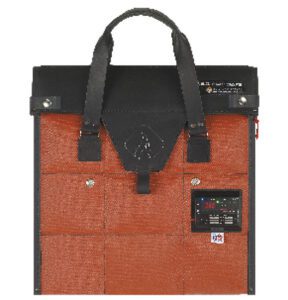
FCC has three lines of bags: the large Emergency Fire Containment System (EFCS), PED Safe-Pak and PED Fire-Safe. The EFCS is made with the same materials as its other bags; however, it has an externally mounted cylinder containing 34 ounces of a fire suppression agent (called Cold Fire) and is charged with nitrogen. The canister is designed to automatically dispense the fire suppression agent once the arming pin has been removed. The EFCS comes in three sizes (24-, 20- and 16-inch versions) and is targeted at large-cabin aircraft. The EFCS is designed to a maximum internal contained temperature of 2600 degrees F. A storage case is included, which may be mounted directly to a bulkhead, or the EFCS can be attached with Velcro. The EFCS has ongoing maintenance milestones, including monthly, annual, six-year and 12-year inspections. The monthly and annual inspections are to determine that the pressure gauge is in the green, the arming lever is in the shutoff position and the tamper-proof seal is intact. The six-year ($400) and 12-year ($600) inspections are done at FCC’s factory, with the 12-year interval inspection including a hydrostatic test and recertification. The bags come in burnt orange or silver grey—not exactly stylish for posh interiors. FCC’s long-term goal is to replace the EFCS with the Fire-Safe bags by providing a significant discount to upgrade to the newest product. The smallest (16-inch) bag is $4450. Pricey, yes, but you get a lot of tech.
The PED Fire-Safe bags contain an external digital temperature monitor, displaying the inside temperature (C or F user selectable), and are powered by four internal temperature sensors. The temp monitor itself is powered with two AAA field-replaceable batteries. The device has three LEDs: Red means very hot, amber is hot and green is normal. The 20-inch Fire-Safe bag is $3650 and the 16-inch bag is $3250.
The new 14-inch PED Safe-Pak bag is based upon the PED Fire-Safe bag, but is smaller and does not have the temperature module and temperature probes. Priced at $1401, it is designed for and targeted at the GA marketplace. However, it’s been a popular seller to business and charter operators and some airlines, who are putting the PED Safe-Pak into cockpits and the PED Fire-Safe into passenger cabins. Each bag is serialized with a certificate of conformance. As an ISO 2001 company, fabric samples from each bag are archived for full compliance. FCC’s bags have a 10-year shelf life, determined by the material used to create the Cold Fire bladders, which can be replaced in the field by ordering a bladder replacement kit (the bladders are contained in Velcro pockets lining the inside of the bag). The bags are made in Ohio by a partner company with over 45 years of sewing experience. All components of FCC’s bags, including the materials, are manufactured in the USA, and all systems (except for the 14-inch PED Safe-Pak) come in a thermal-formed Kydex case and are provided with Velcro. The company offers a lifetime replacement if a bag is used in a fire.
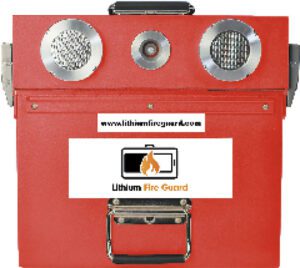
Lithium Fire Guard (formerly Plane Guard) was founded in 2014 focusing on fire containment of thermal runaway devices in aircraft. The original product was designed and patented by Highwater Innovations, which created a joint venture with LFG. The product evolution went through three revisions, which led to the current product—the PG-100—released in late 2018. The design of the PG-100 is focused on protecting cabin occupants from a laptop (and other personal devices) exploding by safely placing them into the fire containment case.
The PG-100 is a hard case with a drawer and a shield, into which the burning device is placed (the internal size of the PG-100 is 16 by 12 by 2 inches). It has two clasps on the side, two handles and weighs a hefty 12 pounds. It’s equipped with two 3M air filters and a water filling inlet. The air filters are designed to filter out the toxic gases generated during cascading thermal runaway, while ensuring that the inside pressure does not cause the entire case to explode.
The $3995 containment case is easy and straightforward to use. During a thermal runaway and at the first sign of smoke or heat from the device, open the PG-100 by sliding the tray out with the shield between the user and the device. Scoop up the smoking device, put it in and close the tray and fasten the clasps. Peel off the air filter’s protective plastic covers (the plastic covers are designed to come off automatically if you forget) and place the PG-100 into an appropriate area away from other combustible items (there aren’t many options in a small cabin).
The PG-100 has a water inlet, which can be slid open to pour water from a standard 500-ml water bottle. This is not a necessary step, but is provided if a second PED enters thermal runaway (yeah, a really bad day). The PG-100 is designed to contain a single small-sized laptop or a few tablet computers and smartphones. The PG-100 is tested to surpass an internal temperature of 1200 F and is serialized for traceability and warranty purposes. The company will customize the size of the case if a smaller or larger one is required. The PG-100 has a 10-year warranty and thousands have been sold to date. Visit www.lithiumfireguard.com.

SIMPLE PRECAUTIONS
Obviously, most of these products are aimed at larger cabins. If you think they’re overkill for your ops (many are), it’s still important to protect occupants from the burning lithium-ion toxins and smoke with smoke goggles and masks, yet few cabins are so equipped. Brimstone’s fire protection mask has a moldable nose bar and flame-resistant elastic straps, a one-point adjustment for a snug fit, a resealable bag and hydrogen peroxide packets (for cleaning in the field). Aerox (www.aerox.com) manufactures high-quality smoke goggles with a tear shield. At $129 (each) they are a cost-effective solution designed to keep smoke and toxins out of the eyes. Ideally, pilots and passengers would don full-face masks and smoke goggles, but that may not be practical. Remember, even with fire containment bags, while the fire will be contained, the spilling of gases into the cabin may not be completely eliminated.
The only thing limiting many of the good fire containment products I found is price. Still, in the confines of GA aircraft, fire prevention accessories make a lot of sense. Like insurance and floatation devices, it’s something that you should have but hope is never used. Think about it—some airplane owners will self-insure their aircraft against all losses, and in the event of an incident with the airplane at rest, there would probably not be any loss of human life, but the aircraft could be completely destroyed. A small-electronics battery fire adds another risk. Investing in basic fire prevention accessories like an entry-level containment bag and smoke masks might increase the hourly operating costs by as little as $3—or less than a cup of barista coffee.
The chances of cabin fires from batteries are quite low. But, with all the battery-powered gadgets we carry on the airplane, that risk could be increasing more than any of us really think about—until the cabin is engulfed in flames.