










Choosing ForeFlight, Garmin Pilot Apps

The landscape is shifting when it comes to choosing either one of these worthy apps. We summarize major differences to help the buying decision.

garmin pilot vs foreflight

In April 2025, Boeing reportedly sold Jeppesen, ForeFlight, AerData and OzRunways to private equity firm Thoma Bravo for $10.55 billion, raising eyebrows across the pilot community. While not all private equity takeovers diminish product quality and inflate prices, aviation has seen this before.

Many of us are bracing for higher costs, fewer updates and a slow drift away from pilot-first design. That’s what led me, a longtime ForeFlight loyalist, to give Garmin Pilot a serious look.

To be clear, this isn’t a deep technical review or a full breakdown of either app—either as standalone could fill an entire manual. Instead, this is a practical, pilot-focused overview of Garmin Pilot Premium versus ForeFlight Premium. My goal here is to help you decide what matters most for the way you fly—which is how you should choose any avionics.

Foreflight: the gold standard?

Electronic flight bags (EFBs) have become essential flight deck tools. Gone are the days of lugging around paper charts, folding sectionals and calculating winds aloft with an E6B. Today’s EFBs offer flight planning, weather integration, performance profiling, charting and even synthetic vision—all from a tablet. For many pilots, an EFB is as essential as a headset.

I’ve been a loyal ForeFlight user since 2012. Over thousands of hours, I’ve relied on it from the early buggy days to today’s data-rich, feature-laden powerhouse. If you ask pilots at any FBO what EFB they use, many will say ForeFlight. And with good reason: It’s polished, powerful and trusted. But it’s also a sizable investment. After Boeing bought ForeFlight in 2019, subscription costs jumped 20 percent three years later. Now, with Thoma Bravo at the helm, many wonder if more hikes are on the horizon.

Moreover, as we reported in the July 2025 issue of Aviation Consumer, Garmin’s Smart Charts—a major modernization for electronic procedural charts—have created enough market buzz where loyal users like me might make the switch to Garmin Pilot. Let’s look at the major categories of features you should consider.

Flight planning

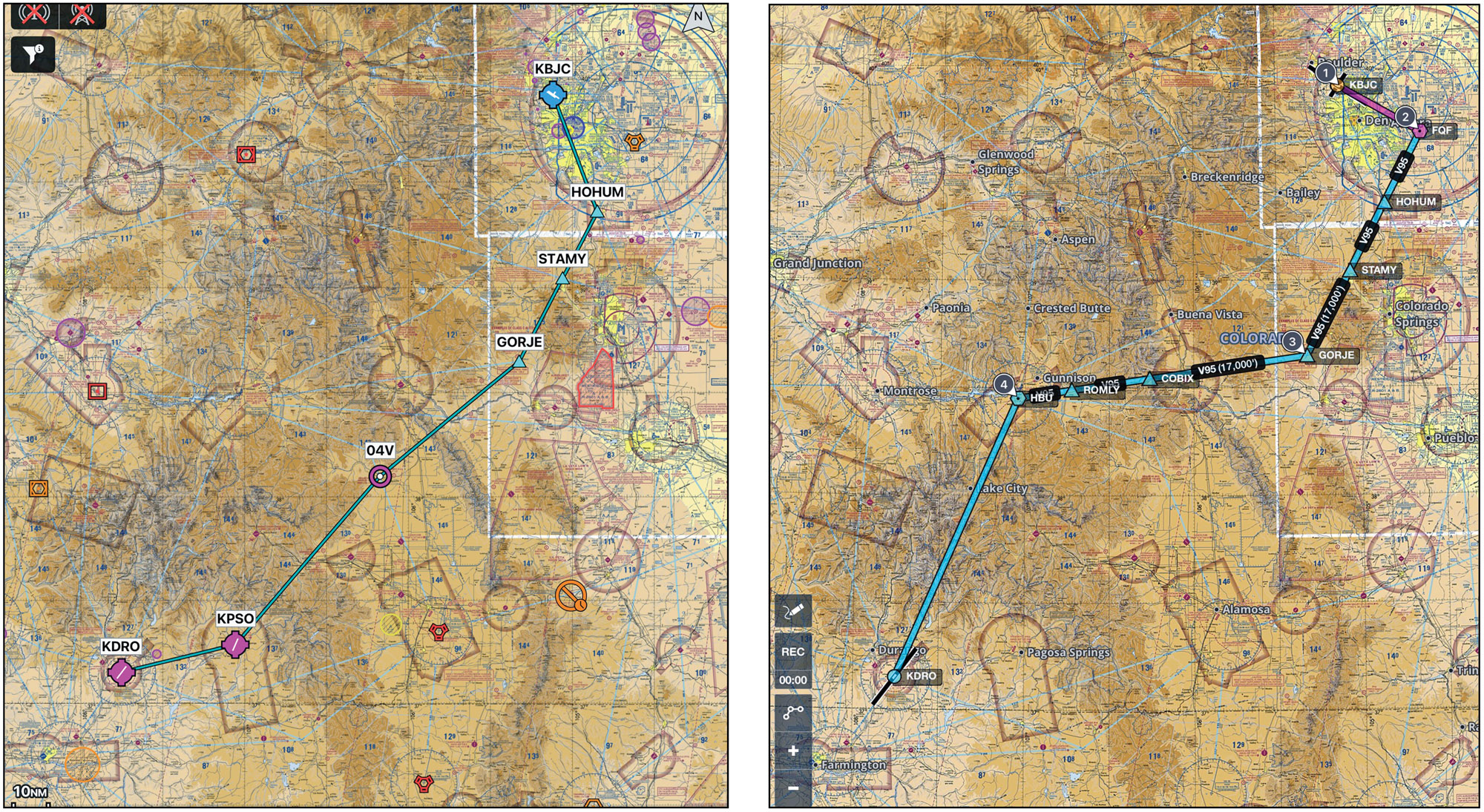
I often fly across the Rockies, where smart routing can make or break a safe flight. On a recent trip from Rocky Mountain Metro (KBJC) to Durango (KDRO), Garmin Pilot routed me KBJC.HOHUM.V95.GORGE.04V.KPSO.KDRO—a route following mountain passes and lower terrain. ForeFlight suggested a more direct KBJC.FQF.V95.HBU.KDRO, which crossed higher peaks, avoiding mountain passes. The screen grabs on page 7 (Garmin on the top and ForeFlight on the bottom) lay it out.

On paper, the difference seems minor. But in a Cessna T310R loaded with my family, eyeing 14,000-foot peaks, the difference becomes real. Garmin’s ability to suggest terrain-conscious routing is pretty impressive.

Both apps have solid route advisors. Garmin’s is organized with tabs to sort by altitude, aircraft type, popularity and date, making it easier to find the right route.

I think ForeFlight does a better job labeling SIDs and STARs by aircraft type (turbine or piston), which is a time-saver when planning unfamiliar airports.

Both apps allow you to file directly via Leidos. Garmin Pilot also integrates with its own FltPlan.com, which could be useful for operators who already use that system. It’s a niche, but also a nice integration.

That’s ForeFlight’s Wi-Fi weather radar depiction, top, compared to Garmin Pilot’s, bottom.

Weather radar and depiction

I tried both apps using Starlink internet and a GDL 52 portable ADS-B/SXM receiver supplied by Garmin. I also had my airplane’s onboard GWX 68 ship’s radar as a reality check. For this discussion, I am focusing on radar imagery when pulled from internet sources or Sirius XM—not FIS-B ADS-B.

ForeFlight’s radar resembles WSI’s—sharp and dramatic. Garmin Pilot’s, by contrast, looks more subdued. On a Denver to New Orleans flight with building thunderstorms, ForeFlight’s depiction looked more intense than reality, while Garmin Pilot’s display more closely matched what I saw on the panel radar and out the window. That’s a big deal.

Overstated radar can ground a safe flight. Understated imagery? That’s dangerous. Ultimately, it’s up to the pilot to decide what they’re comfortable flying in. Recency of experience in IFR and IMC, automation understanding and hand-flying skills are not optional—they’re mandatory.

Garmin’s depiction leaned closer to actual, though both had strengths. ForeFlight has a standout feature: echo tops, which estimate the top of convective activity, invaluable when deciding to go under, over or around weather.

That’s how the FAA weather camera interface looks on the ForeFlight app.

Overlays and map layers

In my estimation, ForeFlight remains the gold standard for map overlays. The interface is clean, fast, and easily customizable. While both apps have features such as lightning, NOTAMs, TFRs, Obstacles, Icing, Turbulence, PIREPs and more, Garmin Pilot’s seems cluttered and less intuitive. I’ve gotten used to it over the past few months; however, I’d like to see a little redesign from Garmin.

ForeFlight’s cloud layer tool is especially useful. It provides horizontal slices of cloud coverage in 1000-foot increments, helping pick altitudes that avoid prolonged IMC—a big deal for passengers and pilots alike. Garmin lacks this.

One thing I’ve come to appreciate in ForeFlight is the integration of FAA weather cameras. These are available both as a map overlay and when viewing airport weather directly, offering near real time visual confirmation of conditions in areas where traditional reporting might be limited or misleading. Sure, you can find these feeds online through FAA or DOT sites, but the point of an EFB is to make flying easier: Easier access, easier planning, easier decisions. ForeFlight leans into that with features like this. Paired with Starlink Wi-Fi, these live camera views are more than just convenient. They meaningfully enhance situational awareness when it matters most, especially in mountainous terrain and marginal VFR. Garmin Pilot offers most of the essential overlays, but lags in depth of choice and ease of use. I gave Garmin an opportunity to respond and it acknowledges there’s work to be done and sees Pilot as a growing, evolving platform.

Aircraft performance profiles

Here’s where Garmin really falters. ForeFlight includes excellent out-of-the-box performance profiles for most GA aircraft. The one for my T310R is so accurate it’s spooky—the profile accurate to within a minute of time en route and half a gallon of fuel burned.

Garmin relies on FltPlan.com for profiles. If your airplane isn’t listed, you’ll need to build one manually. I did, and it took days of tweaking. It’s usable now, but not yet dialed in to ForeFlight’s level.

Chart management

ForeFlight’s chart organization has always been one of my least favorite features. Coming from Jeppesen FD Pro, I prefer charts grouped by logical flow. Garmin Pilot excels here. When you plan a flight, it automatically builds a chart binder with departure, arrival, approach and airport diagram procedures in sequence. Change something? The binder updates.

Garmin’s new Smart Charts feature (available in Premium) is several steps ahead. As recently covered by Aviation Consumer’s Larry Anglisano, these charts are clean, readable and tailored to your airplane and flight. I believe Smart Charts have the potential to reshape charting across all platforms and sway a lot of serious IFR users toward Garmin Pilot.

ADS-B and accessory compatibility

I use a Sentry Mini ADS-B receiver with ForeFlight, but unfortunately, the Sentry line doesn’t work with Garmin Pilot. The Stratus 3 and Stratux devices do, but it’s really too bad that Garmin’s data protocol doesn’t allow for compatibility with more ADS-B receivers. My Sentry Mini becomes a $400 paperweight if I make the switch.

Garmin Pilot doesn’t yet show internet-based traffic, though it recently added this to its web version. Hopefully, the iPad app isn’t far behind.

Something I found rather annoying: Garmin Pilot does not currently provide access to D-ATIS at airports where it’s available, a feature ForeFlight supports. That leaves you no choice but to tune in and listen to an ATIS broadcast, which can be painfully long and slow, especially at busier Class C or B airports.

Verdict: not so fast on the switch

A ForeFlight Premium subscription is $359.99 for a year. The Garmin Pilot Premium subscription is $209.99 per year. That’s a $150 difference each year—and it’s hard to ignore if ForeFlight prices climb again. While ForeFlight delivers more depth and polish, it’s tough to argue that Garmin’s platform is catching up fast.

Still, switching EFBs is like going from iPhone to Android. Garmin Pilot initially felt clunky and foreign, especially without a prebuilt performance profile. But I remembered how awkward ForeFlight was after paper charts. With time, Garmin’s logic starts to make sense.

After 30-plus hours in the air and several months of side-by-side testing, I see serious potential. For me, Garmin Pilot isn’t a ForeFlight replacement yet. But it’s closer than many think. The Smart Charts release is a huge leap forward and might tip the scales for many IFR pilots.

I’m not ready to delete ForeFlight yet, but when renewal time comes, I’m likely not going to resubscribe, especially if prices go up. My biggest holdout is Sentry ADS-B compatibility and wishing Garmin would refine its map overlays. There’s also the issue with aircraft performance profiles.

For everyone else, my advice is try Garmin Pilot for a few months. Run it alongside ForeFlight and give it a fair chance. It will take time to get comfortable with, but if you fly with a Garmin GTN 750 or 650 navigator, the logic might click quicker.

In the end, you might find, as I did, that the gap is narrowing and the value equation is changing fast.

Sy Pinkert

Sy Pinkert works as a captain on the Boeing 737 and flies his Cessna turbo 310 in his off time.