











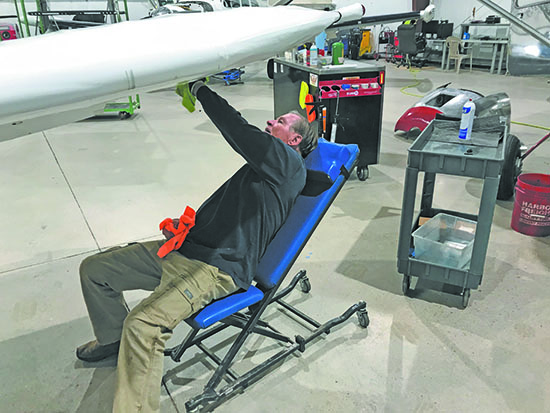
Anyone who works on airplanes—for cosmetics or maintenance—has at one time or another complained about how awkward it is to get to the belly and bottoms of the wings. The belly is often rather low, and on a low-wing airplane, undoing the many access panels on the wings or just degreasing or polishing the underside requires being at different angles—from as low as a standard automotive creeper up to not quite as high as a mechanic’s rolling chair. Enter AeroCreeper, from a company of the same name located in Corinne, Utah (www.aerocreeper.com).
HOW IT WORKS
After my first owner-assisted annual on our Cessna 340, my airplane partner and I sought a solution. We tried various height-adjustable stools, but they were too high. The creepers, even those that lifted your head a bit, were all too low for the wings. We even took a standard creeper and attached it to a motorcycle lift. It sort of worked, but it was far too heavy and unwieldy. We failed, and continued to complain year after year.
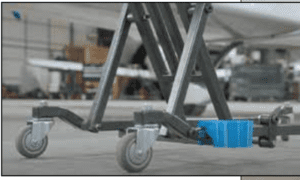
At first glance, the AeroCreeper looks similar to any other metal creeper. But, on closer inspection, you’ll see that it is height adjustable. It doesn’t just raise your head and maybe your shoulders like some other creepers, it raises your whole body, which is exactly what you want. By simply lifting up on the head of the creeper, the whole surface ratchets up and will maintain any of 10 different heights, approximately positioning your shoulders from 5 ¼ inches up to 40 inches off the floor. You’re sure to find a height that works for any place on the bottom of your aircraft.
The cushion of the AeroCreeper is in two sections. When flat, they’re both flat—one under your head down to your back, and the other under your bottom to provide more support as you angle higher and higher from level. On the original $499 version, that seat stays level as it increases in height and the back increases in height and angle from the floor. The $649 deluxe version has an articulated seat that allows you to adjust its angle separately. This is a good arrangement, allowing you to adjust the seat for both comfort and to help you stay on the AeroCreeper when set to intermediate angles.
The AeroCreeper is mostly constructed of box tubing. This provides a suitably rigid and strong structure. At no time did any of our testing (or interviews with other users) raise any issues about strength or structural durability.
TWO VERSIONS
As mentioned, the AeroCreeper comes in two versions. The $499 original version is on a metal frame that supports a backrest and the seat. The backrest ratchets up to different angles and heights while the seat remains level as it rises.
The $649 deluxe version is similar, but the seat can be independently angled separately from the back. It includes an added headrest and heavy-duty casters. Items like the headrest and casters can be retrofitted to the original AeroCreeper, but the adjustable seat cannot. Also available separately are a cup holder and a parts tray. Both proved surprisingly useful.
IN SERVICE
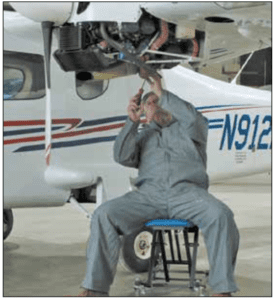
In preparing this review, I found that New Mexico Aero Service—a highly capable and well-respected shop east of Albuquerque in Moriarty (0E0), which maintains many Twin Cessnas, including mine—has an AeroCreeper. I asked each of their mechanics about the AeroCreeper and then asked the person who spends many days each week washing and polishing customer aircraft. Their comments included, “Saves my back.” “I wouldn’t want to be without it.” “Are you kidding? This thing is a lifesaver. I absolutely love it.”
Their unbridled enthusiasm for the AeroCreeper is surprising. Aircraft techs are a demanding bunch. I was expecting positive comments at best, but not this level of praise. Clearly, the design of the AeroCreeper fills a niche to comfortably allow mechanics to work on the underside of airplanes from just the right height.
Of course, no product is perfect. The complaints were first that these things are expensive. Like many devices that do their job so well, though, the expense complaint fades after use. Also, the AeroCreepers are heavy, supporting up to 350 pounds. The original weighs 44 pounds and the deluxe version weighs 50 pounds. So, carrying them around could be a burden, but the casters generally work we’ll so you won’t need to pick them up while in use.
The backrest, seat and optional headrest are foam and covered in rather thin vinyl. The AeroCreeper in use at New Mexico Aero Service was showing a lot of cuts and abrasions to the vinyl. Even the sample I received, while we’ll packaged, arrived with a cut in the seat. In heavy use, I think these cushions will need to be recovered; I’d recommend doing so with a much heavier vinyl.
Those minor nits aside, the AeroCreeper might just be one of the more valuable hangar tools around.
Contributor Frank Bowlin, editor of sister publication IFR magazine, flies and maintains a Cessna 340 in Santa Fe, New Mexico.