







Most paved parking ramps are equipped with tiedown rings, plus adequate rope or chain to do the deed. But some of the most-desirable destinations have nothing of the sort. At back-country airstrips, a friends cow pasture and most fly-ins weve attended, you need to bring your own gear. One option is to assemble a kit from hardware-store items-rope and general-purpose anchors can meet the need. But as with everything else in aviation, if there’s a better way, someone will invent and market it…thus commercial tiedown kits. But are these things worth the money? Are they really any better than the classic cheap doggie auger you can buy at Wal-Mart for under $5? Maybe. Maybe not. While we agree the hardware-store stuff isn’t optimal, we were curious about which of three popular commercial tiedown products are best. To find out, we obtained samples from each manufacturer, plus some gear from our local hardware store, then tried to pull each of these anchors out of the ground. The results surprised even the most cynical among our testing crew and reminded us that what works we’ll in one soil type may not be worth the trouble in another.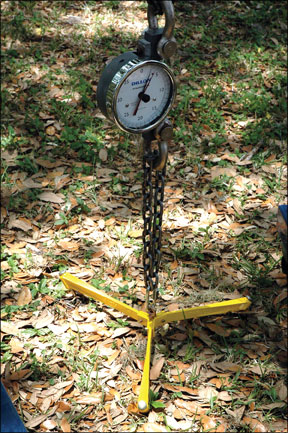
We pulled together three commercial tiedowns from Hunting Solutions (“The Claw”), Flyties and Deal Associates Tie Down Kit. We also obtained two types of anchors from a local hardware store- one flat-plate auger-style anchor and one made from heavy spiraled wire. These latter two anchors are commonly used to secure a tent or tarp outdoors, or-when used with a leash-to keep Fido from running amok in the neighborhood, thus the “doggie auger.”
All three commercial products are variations on the same theme: Take three metal stakes and hammer them into the ground at divergent angles to secure the tiedown anchor. The Claw aircraft anchoring system uses a three-armed base, with a tiedown ring in the center. The base and legs are high-quality cast aluminum powder coated bright yellow. Hammer the stakes through the eyelet at the end of each leg and, according to the company, pulling up on the anchor actually helps tighten the stakes. The Claws kit comes complete with rope, a hammer and a carry bag for storage.
Flyties uses a cylindrical hub or base made from black Delrin, with a tiedown ring mounted in the center. At three points around the base, angled holes are drilled. Hammer the stakes into the ground through the holes at the predetermined angle and youre ready to tie down. The angled stakes resist attempts to pull the assembly out of the ground. Also provided is a T-handle tool for removing the stakes-a nice touch-plus rope and a carry bag.
The Tie Down Kit from Deal Associates uses a small, bright-yellow piece of aluminum angle stock, with holes bored to serve as a guide for the three angled stakes. A large center hole drilled through the apex of the angle is the anchor