











If your
whistles. And few aftermarket engine monitors are equipped or approved for the primary-read “only”-display of information like oil pressure or how much fuel remains in the left tank.
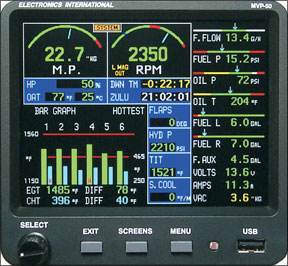
Thanks to offerings from Electronics International (EI), J.P. Instruments (JPI) and Xerion, we can-now or in the very near future-buy new, FAA-approved engine instrumentation systems that offer the latest in software and processing displayed on whats the latest trend: large format color screens.
Experimental aircraft builders have even more choices. The only real issue should be a familiar one to owners: how much to spend and how often will this new gadget divert attention from looking outside the airplane. Thats after you decide where to put it, of course.
Basics Unchanged
We last looked closely at engine monitors in our September 2004 issue. Parameters like EGT and CHT, fuel flow, oil temperature and turbine inlet temperature-along with RPM and manifold pressure-can be displayed on these gadgets in digital or graphic form. Generally, the data is stored in onboard memory and can be downloaded to your PC-perhaps not as seamlessly as you might like-and massaged, graphed and examined as much as you want.
Since that last look at engine monitors, not much has changed in the low- and mid-level offerings. Theyre still necessary, in our view, if you want to run your engine lean of peak EGT or if, like us, you care about knowing the CHT of each cylinder banging away up front. Factory new piston airplanes equipped for cross-country work generally have monitors as basic equipment these days, and often their functionality is built into the glass panels from Garmin and Avidyne.
Changes that monitor manufacturers have made since 2004 generally are in grudging acknowledgement that time marches on and older technology-except in general aviation-is left behind. For example, J.P. Instruments popular EDM-700 and -800 series formerly provided a relatively slow and cumbersome RS-232 serial port as the sole means of retrieving the units data. But try to buy a new laptop these days with a serial port.
Now, JPI has an adapter: Plug one end of the adapter into the serial port and stick a USB thumbdrive into the adapter. Amazingly, Insight Instruments still uses an infrared interface limited to speaking with a palmtop computer long out of production.
All-In-One Replacements
While the low- and mid-range monitors remain relatively unchanged, the newer products-Electronics Internationals MVP-50, JPIs EDM900 and EDM930, Vision Microsystems VM1000C and Xerions AuRACLE I and II-combine the multi-channel brains weve come to expect with larger, color screen multi-function displays. Think of a Garmin GNS530-size screen dedicated to keeping tabs on your engine and systems instead of your navigation, and you get the picture.
There’s some software involved, of course, as we’ll as FAA approvals to use the boxes as primary instruments in certificated aircraft. Not all of these big-screen boxes have those approvals; those lacking it are relegated to Experimentals or OEM installations. Getting one with the Feds sign-off allows you to yank out, tape over or simply ignore your original factory gauges. With exceptions, about the only thing these boxes wont do-for now, anyway-is replace your factory fuel gauges.
If youre flying an Experimental, you can get even more functionality. For example, the big-screen color monitors can handle the fuel gauge issue with ease; all you really need to do is calibrate them for your sensors and tanks. Depending on which manufacturer and model you choose, other functions can be added. For example, EIs relatively new MVP-50 allows custom screens of data like checklists and flight plans, if you choose.
But getting an FAA TSO for the basic hardware is one thing; getting it customized and approved for specific aircraft is another. This includes simple things like allowable oil temperature ranges, but can quickly get esoteric: Some aircraft have