









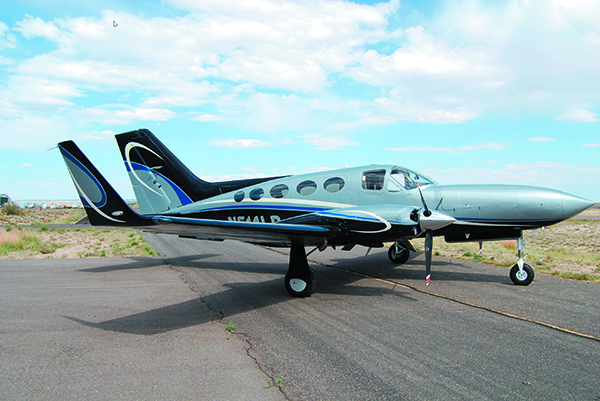
Parts-bin hybrids with spacious cabins and relatively small, efficient engines, 414-series airplanes can carry lots of fuel or a small crowd with their belongings-but not both. Also, the big Cessnas have safety records that are unmatched by any other light twin.
All told, Cessna Aircraft Corp. built nearly 1000 of the airplanes-roughly a 50/50 split between early tip-tanked 414s and wet-wing 414A Chancellors-during 15 years of production. The original intent was for the 414 to be an easy step up to pressurization, and over the years the airplanes have become popular as workhorses for small charter and corporate flight departments, as we’ll as comfortable transports for private owners.
Today, prices range from around $190,000 to over $550,000 for typically-equipped 414s with mid-time engines. Operating and maintenance costs are attractive when compared with those of competing airplanes, such as the big-brother 421 and Beech Aircrafts Duke. Yet, they are not inconsiderable.
In a study of accident records some years ago, the 414 stood out as the safest light twin. Of course, any airplanes safety depends a great deal on the proficiency of its pilots; and there are several good training programs available to help keep 414 pilots in top form. Indeed, many insurance companies insist on such training.
History
Cessna borrowed components from existing 400-series airplanes to come out in 1970 with a model to bridge the price gap between unpressurized and pressurized twins. It had basically the same tail and wide-oval fuselage as the 421B, and the 401s wing. The engines were adapted from those used on the 401 and 402 models-the differences were intercoolers and provisions for bleed-air cabin pressurization. List price was $138,000-$35,000 less than the Duke and some $50,000 less than both the 421 and Pipers P-Navajo.
Engines were 310-HP Continental TSIO-520-Js, and propellers were three-blade McCauleys. According to Cessna, 4.2-psi cabin pressure differential could be maintained by either engine operating at 60 percent power. Six seats were standard; a seventh was available as an option. Maximum takeoff weight was 6350 pounds; max landing, 6200 pounds.
In the years following its introduction, the airplane saw few major changes. One of the most important came in 1973, when cabin length was increased 16 inches, and a fifth side window was installed. Electronic prop synchrophasers became standard equipment in 1976, when two versions of the airplane were put on the market: a bare-bones 414 and a 414II, which came with an assortment of ARC 400-series avionics equipment.
That year, too, most limiting and recommended airspeeds were boosted a few knots (except Vmc, which was lowered from 84 to 82 knots), and the -J engines were replaced with TSIO-520-Ns. The difference is that an -N engine uses 38 inches of manifold pressure, rather than 36 inches, and 2700 RPM to produce its rated 310 horsepower from sea level to 20000 feet. (Actually, the engines can maintain rated power much higher, but manifold pressure limitations are imposed above 20000 feet to preclude excessive internal temperatures.)
The fuel system in earlier 414s is similar to that of other Cessnas with tip tanks; in other words, complicated. Cessna called them Stabila-Tips; the tip tanks were supposed to contribute stability while keeping the fuel supply we’ll away from the cabin. That they do, but they also put a lot of weight at the wing tips, where it contributes considerably to the moment of inertia.
Standard usable fuel capacity of early 414s was 100 gallons (50 in each tip tank). Optional auxiliary and locker tanks were available to boost usable fuel capacity to 180 gallons at first, then to 203 gallons in 1973.
The fuel system in early 414s is complex, especially with extra tanks installed, and proper fuel management keeps the pilot quite busy. The drill is to run the engines off the mains (tip tanks) for 90 minutes before switching to the auxiliary tanks. This makes room in the mains for fuel and vapor returned by the engines. Though the aux tanks feed directly to the engines, fuel from locker tanks can only be transferred to the mains. Before doing so, however, the pilot has to ensure there are fewer than 20 gallons in each tip tank. Fuel transferred too early is merely pumped overboard. And there are only two fuel-quantity indicators, both with three-position switches, to help the pilot keep track.
The system left plenty of room for error, not only on the part of the pilot, but among line personnel as well. When told to top off the mains, a line person may not think to put fuel in the tip tanks. Bottom line: pay attention to the fuel system in earlier 414s.
A simpler fuel system was among a host of improvements unveiled in 1978 with introduction of the Model 414A Chancellor. Tip, aux and locker tanks were obviated by a 4.5-foot longer, bonded wing holding 206 gallons of usable fuel in internal bays. Controls consisted of on/off/crossfeed valves, and a fuel flow computer/indicator was added to the options list.
A 30-square-foot increase in wing area accommodated a 400-pound increase in maximum takeoff weight and a 550-pound increase in landing weight. A ramp weight of 6785 pounds was approved to allow for the consumption of about six gallons of fuel during start, taxi and runup. Also, a zero-fuel weight of 6515 pounds was published (above that limit, only fuel can be added) to preclude excessive bending loads on wing-attach structures.
The 421s longer nose also was grafted onto the 414A, making space for an extra 410 pounds of baggage and avionics. All told, maximum useful load was boosted about 200 pounds, and an eighth seat was added to the options list. Pressurization differential was increased to 5.0 psi to enable the airplane to maintain cabin altitudes of 10,000 and 11,950 feet at cruising altitudes of 26500 and 30000 feet, respectively. Limiting speed for the extension of 15 degrees of flap was raised from 164 to 177 knots; landing gear operating and extension speeds also were increased to 177 knots, from 143.
Beginning in 1978, Cessna offered three basic equipment packages. In addition to the bare-bones model and the ARC 400-equipped 414AII, there was a III version with ARC 800- and 1000-series avionics, a Bendix RDR 160 weather radar and 100-amp alternators.
After the Chancellor debuted, there were few further refinements. One of the most important, though, was the switch in 1979 to TSIO-520-NB engines, which have improved crankshafts. Four years later, Teledyne Continental Motors incorporated some changes to the -NBs cylinders, valve lifters and piston pins, and increased the engines recommended TBO from 1400 to 1600 hours. Continental also published overhaul procedures to enable -NB engines to get the TBO boost.
Despite that, cylinder head cracking has been a persistent problem for the -N and -NB engines (as we’ll as for other IO-, TSIO- and GTSIO-520s). An AD issued in 1986 requires cylinders to be pressure-checked for leaks every 50 hours until the engine has amassed 500 hours.
Other noteworthy refinements to the Chancellor included modification of fuel pickup valves, which raised usable fuel capacity from 206 to 208 gallons, and optional lightweight 100-amp alternators in 1980; and installation of both a fuel manifold valve heater to prevent icing and threadless prop blades, which cut empty weight by 12 pounds, in 1984. The last Chancellors were built in 1985.
Performance, loading
Service ceilings are above 30,000 feet, but few 414 owners fly nearly that high. Most prefer the upper teens and lower 20s, where they get about 190 knots on 32 to 34 GPH at 65 percent power. A pilot in a hurry will see about 205 knots on 38 GPH at 75 percent power.
With relatively high power loadings (10.2 pounds per horsepower for the 414 and 10.8 PPH for the 414A, compared with 9.9 PPH for the 421C and 8.9 for the Duke), the airplanes require a lot of runway. A 414A, for example, needs more than 4000 feet of asphalt to accelerate to rotation speed and, then, screech to a halt at gross weight under standard conditions and at gross weight.
Single-engine performance at sea level is average; about 240 FPM for the 414 and 290 FPM for the A model. This compares with 350 FPM for the 421, 315 FPM for the 340A and 307 FPM for the Duke. At 11,350 feet, the 414s single-engine service ceiling was a bit below average; but, at 19,850, the 414A is tops in its class.
Owner-pilots give high marks to cockpit room and layout of systems controls. Though early ARC radios have earned a poor reputation, one owner indicated his vintage King Gold Crowns arent much better. Owners like the twins handling characteristics, too; only slight trim changes are needed when flaps or landing gear are reconfigured.
The big cabin and copious baggage space are the 414s fortes. The cabin is the same size as the 421s and accommodates up to eight seats. There is enough room in the aft cabin, the nose and wing lockers of a 414 to hold 930 pounds of baggage. With its bigger nose and lockers, the 414A can carry 1500 pounds.
Fuel, baggage and seating capacities provide considerable mission flexibility. You cant fill the tanks, stuff the nooks and crannies, and help seven people aboard, though. With full tanks-enough fuel for nearly 4.5 hours with IFR reserves-a well-equipped Chancellor will have room left in its weight-and-balance envelope to accommodate six FAA-standard people with their toothbrushes. Load a six-person marketing staff with 800 pounds of equipment, and there will be room left for only about 1.5 hours of fuel.Maximum useful load of a 414A is 2430 pounds. Thats 380 pound less than a 421 can hold, but 60 pounds better than the Duke and 315 pounds better than its small-cabin stablemate, the 340A.
Safety record
Statistics compiled by NTSB several years ago showed the 414/414A to have the best records among piston twins both in total and fatal accident rates. Between 1972 and 1982, the airplanes were involved in 0.8 fatal accidents per 100,000 hours flown. This compares with 0.9 for the 340, 1.2 for the 421 and 1.3 for the Duke. (The 411s record of 7.6 fatal accidents per 100,000 hours was the worst of the lot.) Overall accident rate was 3.2 per 100,000 hours, compared with the Dukes 5.6. (Again, the 411, with 16.7 accidents per 100,000 hours, was the pits.)
One reason for the 414s relatively good safety record is that most are flown by professional pilots; but there are several good training programs available for private pilots, as we’ll as pros.
Maintenance
Ensuring that all ADs have been complied with before buying a 414 will take a lot of work, because there have been several dozen of them (not counting a flurry of service bulletins). AD 86-13-4, which requires periodic inspections for cylinder cracks. Other notable directives requiring periodic work include: AD 75-23-8, which requires inspections and service of the exhaust system; 76-13-7, replacement of main landing gear fork bolts; 77-13-22, inspections for crankcase cracks; 82-13-1, inspections of Bendix magneto blocks until they are replaced.
Another AD, 86-1-6, required replacement of a group of Airborne vacuum pumps that had not been manufactured properly. 87-21-2 requires installation of fuel port restrictors to make it a bit harder for improperly trained line personnel to fill a 414 with jet fuel.
There are a few recent ADs of note. The newest is 97-26-16, mandating repetitive inspections of the engine mount beams. Another is 95-24-05, which affects the original equipment McCauley props. It calls for the hubs to be filled with red indicator oil to detect leaks associated with cracks in the prop hubs.
Additional problem areas were brought to our attention by Gordon Cragg, a Texan who makes his living buying and selling 340s, 414s and 421s, and Larry Ball, president of the Twin Cessna Flyer, an owners group. Main landing gear webbing in early 414s apparently is susceptible to cracks and is expensive (100 hours of labor, per side) to fix. Ball notes that hes aware of two instances of complete failure in the last year. Wye components, which direct the flow from both exhaust manifolds into the turbocharger, are particularly prone to cracking. The leaks can lead to corrosion of the engine frame rails, which are very expensive to replace. Pressurization controller diaphragms are good for only about five years. The cabin pressure dump switch on the right gear should be checked regularly. Another area to check, says Cragg, is the firewall, which is subject to corrosion. He also has found cracks in heated windshields to be another recurring problem.
Mods, clubs
Among the most popular mods are the RAM Aircraft Corporation engine swaps. Four variations are available, all of which offer a boost in useful load, increased TBOs, and new props. The top of the line for the 414 is the series VI. In addition to 335 horsepower engines, new props and intercooler scoops, it includes a set of vortex generators, and gives an increase in useful load of 415 pounds. Owners of 414As can opt for the series V conversion, which includes Continentals 350-HP liquid cooled Voyager engines, which have a TBO of 2000 hours. One owner of a series V airplane noted that the liquid cooled engines eliminate the problem of shock cooling on descent. RAM also makes winglets.
VGs are also available from Micro Aerodynamics and V/G Systems. By all accounts, vortex generators really do work and are a no-brainer buy. We highly recommend them.
For those concerned about shock cooling, speed brakes/spoilers are available from Precise Flight and Spoilers, Inc. There’s also a STOL kit marketed by Sierra Industries (formerly Robertson). Finally, some owners install intercoolers from American Aviation.
There is one club that offers extensive support for the 414, in addition to all other twin Cessnas. The Twin Cessna Flyer is headed by Larry A. Ball. (219) 749-2520. Also worth joining is the Cessna Pilots Association (www.cessna.org, (805) 922-2580).
Summing up
A 414 appears to be a good choice for anyone who wants a pressurized airplane with a big cabin and lots of baggage space. Compared to its biggest competitors-the 421 and Duke, a 414 provides a lot of room. Although its slower than the others, a 414 can carry a modest load relatively economically.
It is important to note that a 414 also is seven knots slower than its little brother, the 340, which has the same engines and many of the same systems. And, if its just pressurization youre looking for, and youre going to be flying with only another person or two aboard, you might want to give the 300-series Cessna a look first.
Owner Comments
We represent nearly 2000 owners of Cessna piston twins, and are fortunate to have over 100 members who own and operate the 414.
The 414 is a good example of Cessna getting it right. This aircraft is powered by tried-and-true Continental TSIO-520 engines. Because its pressurized, has a respectable payload and does not have the troublesome geared engines of its big brother, the 421, it is a better value, in our opinion.
Weve found very few problems with the airframe. Corrosion is, of course, always a menace and we recommend anti-corrosion treatment.
The landing gear on the 414 is the same basic electro-mechanical system found on all Cessna twins with tip tanks. This system has had its share of bad press because of frequent failures. We have found through ongoing research and experience that the failures are not due to a design flaw the chronic failure of any one part (the bellcrank under the pilots feet is often mentioned), but due to the lack of timely and important maintenance. All Cessna twins should have the landing gear completely inspected and rerigged every 200 hours or annually, whichever comes first. Following this simple rule will stop a large number of failures.
We receive several complaints each year that Cessna landing gear parts are quite expensive. While this is true, the complaints come mostly from owners who rebuild the landing gear for the first time in years and get hit with a big bill. If the gear got the attention it deserves each year, the cost would be spread out and there would be fewer incidences of invoice-related myocardial infarction.
414s are subject to Cessna service bulletin MEB 76-2, which covers the installation of a reinforcement to the main landing gear side brace attach rib. The bulletin states that the reinforcement kit should be installed on demand when cracks are found. We are aware of two complete failures of the side brace in 400-series Cessnas in the last year. The cost for the kit and installation should run between $5000 and $7500, depending on shop rates. (The kit takes a minimum of 100 hours to install!)
The original 414s came with TSIO-520-J engines with a TBO of 1,400 hours. The engines found on most 414s are TSIO-520-N or -NBs, which produce 310 horsepower and have a TBO of 1600 hours. RAM Aircraft Corporation has 1600 hour engines that are rated at 325 horsepower for the series IV and 335 for the series VI. We have numerous members who are very proud and pleased with the RAM conversions. Our technical support company, TAS Aviation in Defiance, Ohio, has done several of the RAM series VI conversions in the past year. Performance figures for the conversions are indeed impressive.
One thing we have found true of all turbocharged engines is that exhaust maintenance is critical. We have seen several examples of exhaust failure on both 340 and 414 models, which went undetected long enough that severe heat-related damage occurred to the engine rails. The last quote I saw on replacement of an engine rail was a whopping $14,000. A good look at the exhaust at every oil change and inspection would have avoided this costly repair.
We have recently been made aware of new owners having problems getting insurance on the pressurized Cessna twins. Some of the companies are demanding that the first-time owner attend either FlightSafety or Simcom. While additional pilot training is always a part of the budget of ownership of a pressurized twin, this seems a bit excessive. The pressurization system on the 414 is very easy to operate and demands only minimal maintenance. When there is a problem, it can usually be found in a sticky outlet valve or cabin leaks. The door seal needs to be replaced about every 10 years or 2000 hours.
There are several fuel system-related accidents each year. While this system is complex, it is not that complicated to manage and understand. We offer a three-day ground school maintenance and operational procedures training seminar on all Cessna piston twins at different locations several times each year. The systems that deserve, and get, the most attention are the landing gear, engines/props and fuel system. The fuel system often brings forth a lot of discussion from operators who really do not understand the system thoroughly. If an engine-driven fuel pump fails during flight, the fuel in the auxiliary or wing tank on the same side as the failed pump cannot be used. A lot of owners see a pump in the auxiliary fuel feed line on the system schematic, and believe that it can be used to keep the engine running. Not so: its there to remove any vapor from the lines and prevent starvation during tank switching.
If you want an airplane that cruises we’ll between 17000 and 23000 feet, scoots along at over 200 knots on about 35 GPH and hauls five people, full fuel and baggage, the 414 should get some strong consideration. We get a lot of calls from potential owners trying to choose between the 414 and 414A. If you take acquisition costs of the 414A, minimal speed gains and the wet wing fuel system into account, we feel its not worth the extra money. We think that the straight 414 is one of the best values in the pressurized piston twin market.
-Larry Ball, President
The Twin Cessna Flyer
New Haven, Ind.
I have owned a 1982 414A for years. It was converted to liquid-cooled engines by RAM. At 658 hours the engines developed compression problems on the #5 cylinder and spalling of the crankshaft. Continental stepped in and provided completely remanu-factured engines. Though the engines used Mobil AV-1 during their first 150 hours (as originally specified by Continental and RAM) they were then switched to AeroShell. Further work is being done to determine if the oil had anything to do with the problem.
At issue is the fact that in the 550 series engines the hydraulic valve lifters receive oil pressure late. If a plane is not flown often then the lifters collapse and when the engine is started it slaps hard against the crank which causes spalling. While not mandated by Continental we have installed pre-oilers on both engines and take them to 10+ pounds prior to start. We fly the plane about 250 hours per year.
Though Continental has been taken to task many times it is very clear that under new leadership from Bryan Lewis they are extremely interested in customer service. We are back in the air with good engines and they have been extremely helpful to Arapahoe Aero which did the installation and removal.
As an airplane this configuration is hard to beat. For example, when going into Aspen airport you have to make a very steep descent. With gear out we can do 2500 feet per minute and with the liquid cooled engines there is no concern about shock cooling. When landing at Denver Centennial (our home base) from the west ATC generally keeps you at 16,000 until you are about 15 miles out. The descent is very rapid but can be done safely with this plane. When flying non-liquid cooled engines it is almost always required that you lose altitude with some 360 turns or take a very circuitous route. That is harder in IMC.
It is an extremely stable and reliable airplane with excellent instrument handling characteristics. Range is quite good and we can usually make Denver to San Francisco non-stop. The forward baggage locker is cavernous and it is possible to put 6 pair of skis plus other equipment inside. We also have two full size folding bicycles which fit inside easily.
-Barry H. Rumack M.D.
Englewood, Colo.
Our company purchased a C-414 RAM series VI from RAM Aircraft Corporation in August, 1995. In addition to the RAM upgrade, the airplane is equipped with a Robertson STOL kit and vortex generators. Since then, we have operated it for approximately 185 hours and Im very pleased with what we have. RAM modifications are a breath of life for airplanes that would have lost their viability years ago.
Our companys trips are usually within 300 miles of our home base in Jasper, Ala., with three or four passengers on each flight. The RAM 414 with its improved takeoff weight of 6,765 pounds does very we’ll for us on these flights. The extra weight allowance provided by the series VI engines and vortex generators gives us the ability to depart with full fuel (978 pounds) and five passengers. The STOL kit gives us a short ground roll, and climbing at blue line plus 10 knots gives us about 800 FPM at gross weight.
During cruise, we generally operate the engines at 65 percent power settings, which is 32/2300. Overall fuel burn with the new TSIO-520-NB engines is about 42 GPH for the first hour, and 37 GPH after that. Speeds at our typical altitude of 15000 feet average 195 KTAS.
RAM has been helpful and responsive with the small warranty repairs weve encountered. They stand behind their products with good customer support. The aircraft has not been our of service for more than two days at any time since delivery.
Maintaining or replacing some of the older, high-time airframe parts such as the flap motors and gear boxes represents the major cost of operating Cessna twins. I believe some of the repairs needed were due to the relative inactivity of the airplane before we bought it.
-J. Richard Haynes
Jasper, Ala.
We have operated two 414As over the last eight years. We find the airplane to be a solid IFR platform that will give you 199 knots at 10000 feet, or 207 at 15000 with the American Aviation intercoolers. These speeds are about eight to 10 knots faster than stock, but at higher fuel flows, of course.
Our block-to-block fuel flows are 45 GPH. This may seem high, but we never could get the fuel flows promised by American without shaving into the 100-degree cushion on the rich side of peak EGT.
As for cost of operation, it knocked my hat off when we got honest about the numbers. Based on about 150 hours per year, the total cost including everything except pilots salaries is $393.47 per hour. Of that, $120 is unscheduled maintenance and AD compliance, based on $1500 per month. Reserves for engine, prop, paint and interior account for another $80 or so per hour.
Probably the most disappointing thing about owning one of these out-of-production aircraft is the abuse that Cessna heaps on the poor souls who must purchase parts. For a while, the expensive ADs had slowed down on this airplane…then the fuel inlet valve fiasco came along. Not content to let us field check them every 200 hours, the Feds decided to put everyone through this $4500 meat grinder. Replacing an acrylic windshield is like buying a nice 4×4: thats a $25,000 item.
The airplane is we’ll built, has good systems, and can keep a sea-level cabin up to over 10,000 feet. Though no speed merchant, the airplane is respectably fast while sporting true cabin class. The direct-drive engines have far fewer problems than the 421s geared powerplants, and so are cheaper in the long run.
Like most recip twins, the 414A has only anemic single-engine climb performance. Having said that, I have climbed out, single engine, on a warm day at Denver (in the sim at FlightSafety) and was amazed that the airplane could do as we’ll as it did. However, anyone who sticks another 350 lbs. on top of the old gross weight just because he has VGs is painting themselves into a corner on a hot day. The benefit of the VGs is in the slower approach speeds and decreased landing distances. I have flown the airplane (not the simulator) at less than 65 knots straight and level, without aileron flutter. Vmc is virtually eliminated.
The airplanes have been dependable transportation for us. We installed VGs, a coupled Northstar GPS, a Shadin fuel-flow computer, and the intercoolers, and the airplane is about as nice as you will find. I am amazed at people paying $850,000-plus for a new normally aspirated Baron, or $870,000 for a new Malibu Mirage. For that kind of money, you could buy two nice 414As and have some left over.
-Jon Walker
Graham, Texas
We have operated a 1970 Cessna 414 an average of 100 hours a year for five years. During that time I have been the only pilot, and our maintenance has been done by the same shop. We average two hours per trip and always file IFR; 190 knots (65 percent power, 35 gallons per hour average) works very accurately for flight plans. Most of the time, we file for 12,000 to 15,000 feet and rarely have any traffic. We go higher only if weather, winds aloft or a longer trip make it practical.
The 414 is more comfortable for pilot and passengers than any of our previous aircraft. Its more spacious, quieter and has tremendous baggage capacity without CG problems. As a pilot, I appreciate its smoothness, IFR stability and how wonderfully it can be trimmed out. Of all the aircraft I have flown, I prefer the 414 for instrument flying, because you can let go and it hangs in there beautifully. During turbulence its not bad, but its not as good as the Aerostar.
We don’t have air-conditioning but do have the high-speed blower system, which keeps us quite comfortable, even in southern California. The heater system works well; passenger comfort is never a problem.
We have not had any problems getting parts. The engines run beautifully; after 1100 hours since remanufacture, compression and oil consumption compare favorably with new engines. They run smoothly with no skipping or carbon-tracking at altitude.
We know of no other aircraft that offers so much, including pressurization, for the price. In our opinion, we would have to get a propjet for any meaningful improvement, and thats not practical with an average load factor of two.
-William W. Klaus
Granada Hills, Calif.
Also With This Article
Click here to view charts for Resale Values, Payload Compared and Prices Compared.
Click here to view the Cessna 414 Chancellor features guide.