











Composite materials are not news in general aviation applications. Their traditional advantages-less weight, often-greater strength and relative ease in forming complex shapes-are well-known. Those characteristics, coupled with reduced need for skilled labor to, say, build a wing or fuselage when compared to traditional manufacturing methods make them ideal for aviation applications. And, thanks to Cirrus, Diamond and Lancair/Columbia, along with hordes of experimental designers and LSA manufacturers, its the exception these days for a new aircraft design to be constructed entirely from metal. While its not likely we’ll see a non-metallic propeller hub anytime soon, composite prop blades are readily available right now for many engine/airframe combinations and have been for a few years. Both Hartzell and MT Propellers offer composite blades for constant-speed models-MT also offers fixed- and controllable-pitch props-and Sensenich markets a line of ground-adjustable non-metal props for LSAs and experimentals. But, weve been using metal and wood to build props for years: Why go with a composite prop? What benefits do composites offer when made into a propeller and how do the offerings from these three companies differ? How do they compare to wood or metal props, and can you save any money over the long haul by going composite?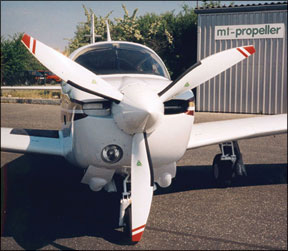
Why Composites?
The same characteristics giving composites an advantage in airframes meant it was only a matter of time before they started cropping up in other major components, like propellers. One solid reason to go with composite prop blades instead of metal is weight: Germany-based MT Propeller says its composite props are significantly lighter than their all-metal counterparts. How much lighter? One STCd MT propeller option for the Cessna 206/207/210 weighs approximately 27 pounds less than a comparable prop from McCauley. Both examples are three-blade models.
Meanwhile, Hartzell also has some good weight-comparison numbers, pointing out a choice of two different props for the Diamond DA40. One is a 74-inch, aluminum-blade prop weighing 62.8 pounds. The companys other choice is a 76-inch composite-blade propeller weighing only 46.8 pounds, despite its slightly larger diameter, compared to the aluminum-blade version. Both are two-blade props.
Performance is another reason to go composite, according to both MT and Hartzell. In addition to the weight savings and how it will impact your airplanes useful load, reduced weight for the engine to spin can translate into less of the available power being wasted by turning the prop. More power is available to put into thrust. Reduced vibration also should result from changing an all-metal prop to composite, since composite materials tend to dampen various harmonics the engine produces, according to MT, rather than support and amplify them as all-metal props can. Not only is reduced vibration good for the prop itself, anything working to dampen