











The thoughts and dreams of airplane owners on a budget, whove had enough bobbling along at 110 knots, may turn to the pre-201 Mooney M20 series. These distinctive airplanes don’t cost a fortune and they fly fast (140 knots or so), sipping only a gallon or two more per hour than a 172. If you find an older Mooney that has been we’ll maintained, has a low-time engine (watch out for those Lycoming 360 ADs) and the most popular mods, whats not to love?
Age is one concern. The last pre-J M20 dates to 1978 and the biggest numbers were produced in the 1960s, before one of Mooneys serial bankruptcies, which itself is a worry for owners. The earliest had wooden wings. Some of the rest had corrosion problems and fuel tanks with sealant trouble. A bladder mod has an AD. Resale value is another issue. The 3700-plus 1977 J and later models, from the 201 onward, keep a lid on the prices of earlier M20s, no matter what their mods and panel improvements. For the rare owner who doesnt care – the one with a budget who wants an airplane to use and love forever – a pre-J Mooney can be a beautiful thing.
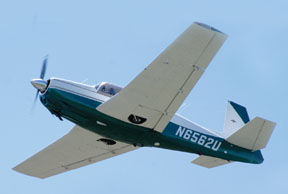
MODEL HISTORYThe M20 series evolved in 1955 from Al Mooneys “Wee Scotsman,” the Mooney Mite M-18, a single-seat, low-wing, speedy little airplane with manually retractable gear cushioned by rubber “donuts.” Mooney designed it in the 1940s for simplicity, speed and efficiency. In addition to the donut cushions and the “Johnson bar” for operating the gear, which would remain an M20 model feature until 1969, the Mite introduced the famous “backwards” vertical stabilizer that supposedly improved spin recovery and remains the Mooneys trademark.
The pre-201 Mooneys, launched as a four-seat version of the Mite, are those that came before the Roy LoPresti aerodynamic redesign with the J model in 1977, which boosted cruise speeds about 10 to 15 knots. The first M20, the four-seat Mark 20, built from 1955 through 1958, had a wooden wing and tail. Powered by a 150-HP Lycoming O-320 with a constant speed prop, it gave way in 1958 to the metal-tailed M20A, powered by a 180-HP Lycoming O-360 A1A. It still had the wooden wing. These two models, of which nearly 700 were built through 1960, had the worst in-flight break-up record of any small airplane and ADs that required inspections of the wing and tail for rot. You can buy one for less than $25,000, though, and cruise at better than 140 knots.
The B-model Mark 21, made only in 1961, got rid of the wood and boosted the standard fuel capacity from 35 to 52 gallons. Its metal wing design, with few changes, is still in production. The B quickly gave way to the most ubiquitous of all M20 models, the C, in 1962. It had an engine change to the O-360-A1D, more rudder travel, a hand-pumped hydraulic flap actuator instead of a mechanical linkage, increased flap deflection and a 125-pound increase in useful load. The C remained in production until 1977. More than a third of the 6200 pre-J M20s were C models.
Mooneys success inspired it to try an economy version: the Model D Master with fixed gear, which cost the design 20 knots or so. Only 60 were made from 1964 through 1966 and its rare to find one that hasnt been converted to retractable gear. The same year saw Mooney try a pricier package, too. The Model E Super 21 Chaparral introduced the 200-HP Lycoming IO-360-A1A, making it the first of the Mooneys without a carburetor heat control.
In 1965, Mooney introduced its Brittain-made wing-leveler as a standard feature on all models, calling it “Positive Control” because it was always on unless the pilot pressed a release button on the yolk. Either loved, hated or put up with, it probably prevented some graveyard spirals and remained a feature until the 201 came along.
Known for its tight fit as we’ll as speed, the M20 fuselage got a foot-long stretch with the Model F Executive in 1966. Three were made as that year ended and 536 in 1967, more in one year than any model before or since. Like the C and E, the F remained in production until the paradigm shift of LoPrestis 201. In 1969, they all got one-piece windshields, a popular mod now for earlier models.
The M20G in 1968 matched the C models 180-HP engine with the longer fuselage and lasted two production years. A more notable and costly loser was the M22 pressurized Mustang. Introduced in 1968, it looked like a tank and helped tank the company, which went bankrupt in 1969. Butler Aviation bought Mooney and stopped production in 1972. Republic Steel bought in and started making Mooneys again in 1974. Republic spun off the design for a Mooney 301, which Socata built as the TMB700, and merged the company with a French firm in 1984.
There was another bankruptcy in 2001 and another in 2004. One of the players, the Mooney Aerospace Group Ltd., has been rebuilding the Mooney Airplane Company since then under a court-approved reorganization plan. It introduced the M20TN Acclaim at Sun N Fun this spring. Powered by a 280-HP Teledyne Continental TSIO-550G with twin turbochargers and dual intercoolers, it goes fast and costs a lot. If youre looking into pre-J M20s, try not to think about it too much.
MARKET SCAN
Its been a buyers market for a while, as The Mooney Owners of America magazine, Mooney Pilot, described it last fall. The Spring 2006 Bluebook average price range for pre-J M20s went from $20,000 for a 1955-1957 M20, $39,000 for a 1961 M20B, $45,000 for a 1965 Model C into the $50,000-and-up range from 1969 to 1971 and in the $60,000 range after 1974. The Bluebook put a 1978 Model C at $67,000 and a 1977 Model F at $72,000. Nothing quite compares to a Mooney for speed and efficiency but other step-up airplanes are generally priced higher. A 1967 Cardinal RG is Bluebooked at $67,000. A 1978 Piper Arrow comes in at $76,000. Forget a 1977 182Q, which the Bluebook puts at $99,000. Accept lesser airplanes and the prices get closer. A 1978 Sierra is listed at $61,000 and so is a 1978 fixed-gear Cardinal. A 1980 172 RG Cutlass is listed at $65,000.
PERFORMANCE
Mooneys are all about getting speed without spending a lot of money. Most older models have a 180-HP engine; some the 200-HP fuel-injected Lycoming. A 172 owner who steps up to a mid-1960s Model C is going to be thrilled watching the world slip under the leading edge at a noticeably higher pace while flight planning for 10 or so gallons per hour.
The pre-1977 Model-C Ranger, for example, cruises at 150 knots, the Bluebook says somewhat optimistically. It has a sea level rate of climb of 860 FPM. Takeoff over a 50-foot obstacle is listed as about 1400 feet and landing over one requires 1550 feet.
Mooneys perform we’ll on 180 HP by having low drag, which requires sacrificing space. It feels like you wear a Mooney and, to some, thats part of its pleasure. There’s a sports-car slouch required to slip behind the controls and the pilot sits low with his legs stretched under the panel – a possible problem for short pilots. Those used to sitting up high and having a good view out and below will feel a bit claustrophobic. Because the cowling may not be in the pilots field of view, different sight cues are needed during landings.
These airplanes are famous for being hard to land. That may have more to do with poor basic training and bad habits that slower singles let pilots get away with. The Mooney, with its rubber-donut gear, is easy to grease on if the approach is stable, speed on short final no more than 75 knots, the roundout is not made too high and the nose is held off. At higher speeds, its slippery design will float in ground effect. Thats where pilots get in trouble, over-controlling or dropping it on, inducing a bounce, then letting the nose fall through and hit the runway. Thats how pilot-induced oscillations start and woe to the transitioning Mooney flier who dumps the nose on the runway.
In crosswinds, there is also a legend that Mooneys are tricky. Again, good speed control, cross-control technique and judgment make up for any quirks, especially in C and later models, which have more rudder travel than the early M20s.
Short-field operations can be a challenge. Pilots used to Cessna flaps, for example, will find the Mooneys almost absent and, as noted, the airplane will float if approach speeds are too high. Speed brakes are a popular mod in later models. The problem with them is a tendency to sink in the pattern and have to drag it in on final. Just carry more power than you used to once those brakes are deflected.
Mooniacs, as the devoted call themselves, love the older models with the Johnson bar for operating the manual gear. The gear has low operational speeds, however, so it cant serve as a speed brake for en route descents. It also takes a lot of muscle to retract if the pilot lets the speed build too high on departure.
There’s not a lot of room in a Mooney, but load-carrying ability is not bad. Squash four people into the airplane, fill the tanks and youre in trouble in most four-seat airplanes. The useful load of a Mark 21 Model C is 1050 pounds not counting any mods and new equipment, which are common on these older models. That leaves, at most, 738 pounds for people and baggage. Pilots have commented that these airplanes are perfect cross-country machines for one or two people and their bags.
Roll response is often called “truck-like.” The Mooney is controlled with pushrods, not cables, and some pilots like their solid feel. Its heavy aileron feel makes it a good IFR airplane and the Positive Control feature, on those models that have not had autopilot upgrades, is simple and helpful when there’s work to do in the cockpit.
Good rudder control to prevent yaw is crucial when practicing stalls in a Mooney. The airflow over that clean wing breaks abruptly and one wing often will drop. Lower the nose, pick it up with aggressive rudder and all will be well. Spins are not for the faint-hearted (or legal-minded). you’ll need at least 1000 feet to recover.
MAINTENANCEPre-J shoppers should study up on a number of issues involving these models and check logbooks carefully. For the pre-buy, use a mechanic who really knows Mooneys. Problem number one is the old wood wing and tail. don’t go there. Problem number two is corrosion in the fuselage tubing. The Mooney is known as a very we’ll built and very strong airplane. It has a very low break-up rate and a virtual “roll cage” around the cabin. Rust doesnt care. The older models seem less prone to it, in part because there was less sound insulation to trap moisture. Watch out especially for models built in the late 1960s and early 1970s, before Republic bought the company. Cost-cutting as bankruptcy loomed included less rust-proofing. Be familiar with Mooney Service Bulletin M20-208B from August 1989, which calls for corrosion inspections.
Another common problem is deteriorating fuel-tank sealant that contaminates fuel and causes engine failure. A 1985 AD covers the tanks. Other ADs include one in 2004 for airplanes with the popular O & N bladder fuel cell mod, the result of reports that rainwater was entering the fuel bladders.
Over the years, there also have been ADs involving cracked aileron control links, the original Dukes fuel pump, the electric gear, the control wheel shaft, ingestion of air filter screens and gaskets and corrosion in the control rigging and landing gear. There have been very few recent ADs, however. Good logbooks or a good mechanic (and perhaps a big check for catch-up work) should be vital to any buyer.