











Airplanes are compromises: Theyre never large enough, fast enough or light enough for all potential customers. And going faster is always a popular upgrade. After all, we don’t fly airplanes to go slow. Of the two basic ways to increase top speed-clean up the airplanes aerodynamics or stuff in a larger engine-each has their benefits and drawbacks. But when one method has been tried, or reaches the point where further refinement isn’t cost effective, designers turn to the other.
Mooneys M20 series is something of Exhibit A for this practice: The basic airframe had been cleaned up over the years and powered by different engines, resulting in
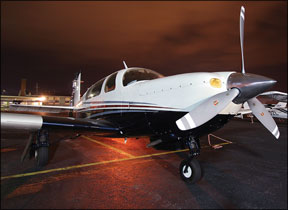
iconic models like the M20J Model 201 and its turbocharged sister, the 231. But after those models saturated their markets, going faster still meant bolting on a different, larger powerplant. After all, there’s no replacement for displacement. In this instance, take a long-fuselage Mooney, trade its small Lycoming for a big-bore Continental, make a few other refinements, and the result is a comfortable190-knot speedster known as the M20R Ovation. Still in production today, the Ovation has seen its share of evolution.
History
After tragic teething pains-the original M20 saw several in-flight breakups, resulting in abandoning wooden wing components-the basic Mooney airframe has been essentially the same since the M20C of the early 1960s. It consists of a semi-monocoque rear fuselage, metal-skinned steel tube cabin, a long and slender tapered wing and a distinctive tail with unswept leading edges. As well, major systems have remained unchanged throughout: Trim is accomplished via a jackscrew moving the entire empennage; controls are pushrod-driven and the landing gear still uses a stone-simple trailing link design, with shock absorption handled by stacks of solid-rubber donuts.
The company, too, has been through some refinements. It changed hands more than once, encountering management and quality-control problems along the way. By the mid-1970s, the line was looking a bit dated and the company was in trouble yet again. Fortunately for Mooney, the right man for the job was in place: LeRoy LoPresti had earned legend status for his ability to get the utmost from an airplane through aerodynamic cleanups. Already famous at the time for his work at Grumman-American, he applied his talents to the M20 series, resulting in the Mooney 201, which stood for the airplanes top speed in MPH. LoPresti made a number of changes, including a new cowling and more aerodynamic windshield. The interior was redone as well, with a new panel. Gone, too, were the old Mooney naming conventions (names like “Executive” and “Statesman”).
The 201 became the pattern for all Mooneys to follow. Its first sibling was the turbocharged 231 (M20K, a designation also applied to the 252/Encore models), with its 210-hp Continental TSIO-360. In the 1986 model year, the M20K morphed into the 252, which lasted until 1990, and was resurrected with 220 hp as the Encore for 1997/98.
The short-lived Porsche-engined PFM (M20L) was the first of what today are known as the “long-body” Mooneys, even though the M20J/K models had been stretched once already when compared to their M20C/D/E forebears. Lasting only two years and for 41 copies, the PFM begat the M20M, debuting as the TLS. It was the first true “big-bore” Mooney, sporting a turbocharged Lycoming TIO-540 of 270 hp. Known as the TLS/Bravo and later, simply Bravo, it went out of production in 2006 when the company shifted all its current powerplants to Continentals 550 cubic-inch platform. In 1999, Mooney dropped the M20J/201 in favor of the M20S Eagle, also built on the longer fuselage first used for the M20L.
The Ovation series, also using the long fuselage, first appeared for the 1994 model year, rolling out the factory door at an average equipped price of $281,500. From the beginning, it was powered by Mooneys version of Teledyne Continental Motors popular IO-550, the -G, featuring a tuned induction system. The IO-550-G lacks altitude-compensating fuel metering, so the pilot must lean the mixture manually. Mooney derated the IO-550-G to 280 horsepower by limiting maximum rpm to 2500. This probably contributed to the engines official 2000-hour TBO when other IO-550s saw only 1700 hours. Whether thats a realistic number wont be known until the aircraft accumulates some history, so buyers are duly cautioned not to bank on the high TBO. That said, one owner reports his Ovation made it to TBO, albeit with a top overhaul along the way.
Once prized for squeezing lots of knots out of relatively small engines, Mooneys are no longer taking a back seat in the horsepower race. In the process, most of the “easy” aerodynamic tweaks seemingly have been applied, leading to more horsepower as the quickest, easiest path to greater speed. Today, the Mooney lineup consists of the M20R Ovation 2 GX (280 hp), the Ovation 3 (310 hp IO-550-G with a 2000-hour TBO), plus the Acclaim and Acclaim S, both basically turbocharged versions of the 280-hp Ovation 2 GX with 2000-hour TBOs. It would seem the IO-550s TBO “issue” in Mooney airframes-if there ever was one-has been resolved.
Not Your Fathers Mooney
Compared to earlier Mooneys, the most noticeable difference on the Ovations exterior is a new sculpted cowl sloping down to a pair of too-small-looking cooling inlets. These inlets still manage to provide adequate airflow. No cowl flaps are fitted so cooling air exits past the dual exhaust pipes.
The interior belies Mooneys reputation for cramped and uncomfortable cockpits.