











Airguide Publications Flight Guide has long been to airport information what Jeppesen is to approach plates: Much of the same information you could get from government or other sources, all collected in a neat package with superior layout and design. It was inevitable Flight Guide would come out for the iPad. The latest version adds the features required to be a contender in the field, such as georeferenced approach plates and a moving map. It also adds integration with Flight Guides own GPS receiver, which paves the way for ADS-B or XM weather integration into the app.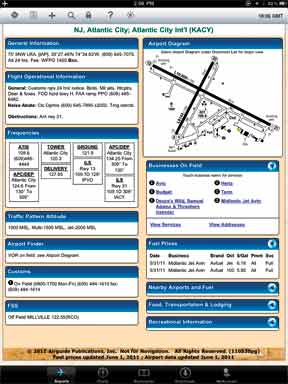
Boutique Airport Data
Flight Guides strongest card is their airport information and graphics. Theyre just easy to read. Case in point was a VFR flight down to Atlantic City, N.J. The direct VFR route bisected Restricted areas R-5002 A-E. Looking up the altitudes for all of these is usually an annoying task of digging around on the margin of the sectional chart-which, by the way, is impossible on a seamless sectional used by most iPad moving maps-to find the airspace details. But on the Flight Guide airspace graphic, it couldnt possibly be clearer. Common VFR reporting points and prominent landmarks are also handy features. Admittedly, only larger airports merit this bonus page.
The same is true of the airport diagram on the airport page. In addition to the usual data, the location of windsocks is noted, as we’ll as numbered flags that cross reference to details for car rental, dining and the FBO. The diagram quickly expands or shrinks with a double tap, and shows your position on the field if the iPad has a GPS position fix. A plus of Flight Guide has always been offering diagrams of far more airports than the government does.
If the iPad has an internet connection, METARs, TAFs and fuel prices (at that airport and nearby) load automatically. We did wish the iEFB would grab a nearby METAR for airports that don’t have their own, but thats a minor point. You could argue the Flight Guide data and diagrams don’t leverage the color available on the iPad, as they are reprints of the paper versions. But on the plus side, this made them easily readable even in direct sunlight. The iEFB also offers a dimming feature for nighttime.